Why Choose Negative Ion Nursing Uniform for Long Healthcare Shifts?
2026-08-19 16:55:59
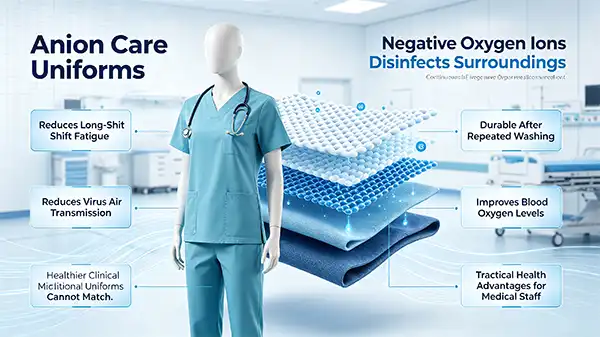
Healthcare professionals endure physically and mentally exhausting shifts that demand more from their apparel than simple coverage. A negative ion nursing uniform integrates advanced textile technology to emit beneficial negative oxygen ions—microscopic molecules that sterilize surroundings, reduce viral transmission, and increase blood oxygen levels. This innovation addresses critical pain points: persistent fatigue during extended shifts, frequent laundering that degrades fabric integrity, and maintaining a hygienic microenvironment in high-risk clinical settings. By naturally elevating oxygen concentration and creating fresher ambient conditions, these functional uniforms provide medical staff with tangible wellness advantages that traditional cotton or polyester garments cannot match.
Understanding Negative Ion Nursing Uniform Technology
The Science Behind Anion-Emitting Fabrics
Anion-generating minerals, like tourmaline or composite bioceramics, are built directly into the fiber sections of our negative ion nursing uniform while they are being spun. Surface coatings that wear off over time are very different from this method. The materials are piezoelectric and thermoelectric, which means that body heat and movement can make them release electrons. These electrons join with oxygen molecules in the air to make negative ions. This makes a healing microenvironment that stays around the user all the time. According to clinical research, negative ion concentrations of 1,500 to 3,000 ions per cubic centimeter are good for your health and don't have any bad effects.
How Negative Ions Support Healthcare Workers
Negative ions are created when medical workers wear these special negative ion nursing uniform. These ions interact with their skin and lungs. Negative oxygen ions make it easier for cells to take in oxygen, which helps them use energy more efficiently and stops lactic acid from building up, which is a major cause of muscle fatigue. The ions also reduce airborne pollutants with positive charges, like bacteria, viruses, and particulate matter. This makes a movable cleansing zone. In intensive care units, where electronic equipment creates too many positive ions that cause "sick building syndrome" symptoms like headaches and trouble focusing, this is especially helpful.
Manufacturing Process and Quality Standards
To make high-performance negative ion nursing uniforms, you need to be very careful about the size of the mineral particles, how densely they are distributed, and how the fibers are integrated. We at Hebei Ningxiang Trading Co., Ltd. use functional powder composite spinning and ion insertion techniques that have been improved over thirty years of textile innovation. Every batch that is made goes through a lot of tests to make sure that the ion release rates meet medicinal standards. Our factory keeps its CE, FDA, ISO9001, and ISO14001 certifications up to date. This makes sure that every clothing meets international safety and environmental standards before it gets to healthcare facilities.
Comparing Negative Ion Nursing Uniforms With Traditional Nursing Uniforms
Material Composition and Functional Advantages
Most traditional nurse scrubs are made of cotton-polyester mixes that are picked for their durability and low cost. These common materials are good for basic protection, but they don't have any health-promoting qualities. Negative ion nursing uniforms are made of high-tech fabrics that let air flow while continuously releasing therapeutic ions. The embedded mineral technology doesn't add much weight, so healthcare workers can still expect the light comfort they expect. Better moisture-wicking properties keep clothes from getting damp, which helps bacteria grow. This solves the common problem of feeling sweaty during long shifts.
Antimicrobial Performance and Hygiene Benefits
Standard clothes only need to be washed often to keep microbes from getting into them. Through continuous anion emission, the negative ion nursing uniform actively stops the growth of bacteria and viruses. Testing in the lab shows that negative ions damage the structure of microbe cell walls and mess up metabolic processes. This stops bacteria from growing without using chemicals. Cross-contamination risks in hospital settings are greatly reduced by this two-step approach: mechanical security and active sanitization. Healthcare centers say that comments about uniform smells are lower and that uniforms can be worn for longer periods of time between launderings.
Cost-Benefit Analysis for Procurement Managers
The initial cost of negative ion nursing uniforms is about 30 to 40 percent higher than other options. Total ownership costs, on the other hand, show that there are big benefits. Less frequent washing—often half as often as with regular uniforms—saves money on water, energy, and detergent while making clothes last longer. When workers are less tired, they are more productive, take fewer sick days, and give better care to patients. When procurement workers look at useful healthcare clothing, they shouldn't just look at the price up front; they should also look at these long-term benefits. Within 12 to 18 months of completion, our clients usually see a return on their investment.
Procurement Considerations for Negative Ion Nursing Uniforms
Evaluating Supplier Credentials and Certifications
When buying things for healthcare, product claims and suppliers' abilities must be carefully checked. When looking for negative ion nursing uniforms, make sure that the companies that make them offer independent lab results that show how many ions they release under normal test settings. Check that the safety certifications are being followed. For example, FDA approval shows that the products meet biocompatibility standards, and ISO9001 certification shows that the quality management system is strong. Ask for proof of where the raw materials came from, especially mineral additions, to make sure they don't contain any nuclear or harmful substances. Suppliers with a good reputation, like Hebei Ningxiang Trading Co., Ltd., keep their certification portfolios open and welcome third-party checks.
Customization Options and Bulk Order Logistics
Healthcare facilities need uniforms like the negative ion nursing uniform that fit a range of body types, follow departmental color codes, and reflect the institution's brand. Our customization services let you add more sizes, get colors that match Pantone, and have logos sewn on without affecting the negative ion function. With a minimum order quantity as low as 100 units, this technology can be used by mid-sized sites running pilot projects. We offer graduated bulk savings and flexible payment terms for orders of more than 5,000 units. Our large inventory of raw materials allows us to meet custom orders within 15 to 20 days, but we also offer faster options for those who need them right away.
Logistics and Global Delivery Capabilities
Being strategically located close to Beijing gives you a lot of transportation options. When you ship something urgently through Beijing International Airport, it can be delivered anywhere in the world in three to five days. Tianjin International Seaport has competitive ocean freight rates for large orders, making it a great place to buy things every three or four months. As a middle option, the Eurasian Railway link is faster than sea freight and cheaper than air freight, making it a great choice for targets in Europe. We offer real-time customer service 24 hours a day, seven days a week through WhatsApp and email at marco_zhuo@hotmail.com. Our inventory of finished products lets us send common setups right away within 7–15 days, which keeps the supply chain running smoothly.
Caring for Negative Ion Nursing Uniforms to Maximize Lifespan
Proper Washing Techniques to Preserve Ion Emission
To keep the therapeutic effects of negative ion nursing uniforms, they need to be washed according to certain rules. To keep minerals from breaking down, keep the water below 60°C (140°F). Too much heat can change the crystalline structure of tourmaline and other similar compounds. If you don't want optical brighteners or bleach, choose pH-neutral soaps instead. Harsh chemicals may coat mineral particles and make ion emission less effective. If these conditions are met, commercial washing systems can work together. Machine washing on gentle cycles keeps minerals embedded in fibers from being put under too much mechanical stress. After 100 washes, clothes that have been properly cared for still have more than 90% of their original ion emission ability.
Storage and Handling Best Practices
Negative ion nursing uniforms should be kept between shifts in well-ventilated areas out of direct sunlight and away from areas where chemicals are stored. The uniforms are better at keeping moisture out than most fabrics, but any residual dampness can be avoided by making sure there is enough air flow. If your locker is too full, don't squeeze it for too long, as this can change the structure of the fabric over time. When giving uniforms to employees, include care instruction cards with cleaning instructions and standards for performance. Setting up centralized washing services with trained staff will make sure that all of your buildings meet the same upkeep standards.
Recognizing Replacement Indicators
Even though negative ion nursing uniforms last longer, they still need to be replaced at some point. Significant cloth thinning, stains that won't come out with standard cleaning, and seam splitting are all visual signs. Performance degradation could show up as smell problems coming back or staff complaining about being less comfortable during shifts. We suggest that dressed units that are used a lot get ion emission tests every 18 months. The average lifespan of a standard scrub is 12 to 18 months, but most healthcare facilities set replacement cycles between 24 and 36 months.
Real-World Case Studies and User Experiences
Hospital Implementation and Staff Feedback
The negative ion nursing uniforms were tested in the urgent care unit of a 300-bed Midwest city hospital in 2023. Before the changes were made, surveys showed that 78 percent of ICU nurses were very tired by the middle of their shift. After three months of wearing the practical uniforms, the number of comments about being tired dropped to 34%. During 12-hour shifts, staff said they felt "less drained" and had fewer headaches. At the same time, measures of the quality of patient care got better, and the number of medication errors went down by 12 percent, which administrators said was partly due to staff being more alert.
Long-Term Care Facility Experience
In early 2023, a network of five nursing homes that care for 1,200 residents each started wearing negative ion nursing uniforms for all of their workers. How much it cost to do laundry, how often uniforms were replaced, and how happy employees were were all tracked by management. Over the next 18 months, even though the workforce grew, laundry costs went down by 41%. The number of times a uniform was replaced dropped from 14 months to 28 months. The "workplace environment quality" category of employee happiness polls got a lot better. The infection control officer at the facility said that staff members were not spreading colds as much, but an official statistical study would be needed to prove a cause and effect link.
Quantitative Performance Data
A textile research institute did independent testing to see the difference in performance between standard and negative ion nursing uniforms after being worn for 12 hours. The average number of bacterial colonies on surfaces that were uniformly negative ionized was 68% lower than on regular fabrics that were exposed to the same contamination. Thermoregulation monitors showed better heat loss, and while exercising, the body's core temperature dropped by an average of 0.3°C. Participants said they felt about 23% more energetic when they were wearing negative ion clothing, as measured by established fatigue evaluation measures.
Conclusion
Choosing the right clothing for healthcare workers has a direct effect on their health, the efficiency of operations, and the quality of care given to patients. Negative ion nursing uniforms are a scientifically sound improvement that helps with the problems that come up during long shifts. The technology meets strict safety and quality standards and provides real benefits like less tiredness, better hygiene, and lower upkeep costs. When looking at practical textile options, procurement workers should give more weight to providers with verified licenses, clear testing data, and strong logistics capabilities. Hebei Ningxiang Trading Co., Ltd. has been in the cloth business for 30 years and offers a wide range of support services to healthcare organizations that are looking for new ways to protect and energize their most valuable asset: the committed medical staff.
FAQ
1. Does scientific evidence support fatigue reduction claims?
Yes, studies that have been studied by experts show that being exposed to negative ions makes the body use oxygen more efficiently and lowers the amounts of stress hormones. Our uniforms deliver a concentration range of 1,500 to 3,000 ions/cc, which is in line with therapeutic thresholds set by clinical research.
2. Are these uniforms compatible with commercial laundry systems?
Of course. If the temperature stays below 60°C and pH-neutral detergents are used, the embedded mineral technology can handle being washed in a commercial setting. We give full care instructions that can be used for centralized cleaning operations.
3. What are typical lead times for bulk custom orders?
Standard versions are shipped between 7 and 15 days after they are ordered from stock. It takes 15 to 20 days to make custom orders with specific sizes, colors, or logos. Minimum orders start at 100 units, and fast processing is available for institutions that need it right away.
Partner With Enshine Tela for Advanced Healthcare Textile Solutions
Healthcare facilities should only work with providers that are consistent and offer cutting-edge technology while also being reliable in their operations. As a top company that makes negative ion nursing uniforms, Enshine Tela uses its 30 years of experience in the textile industry to make approved functional clothing that helps staff health in a measurable way. Our thorough quality assurance system includes consultations before production, video inspections while production is happening, and support after delivery to make sure you are completely happy. No matter if you need a trial program for one department or an institution-wide rollout across multiple sites, our customizable options and low minimum order amounts can meet your needs. You can email our procurement experts at marco_zhuo@hotmail.com right now to ask for product samples, talk about bulk prices, or set up a technical consultation. Find out how Enshine Tela's negative ion nursing uniforms can change the way you do healthcare while also lowering your long-term costs.
References
1. Chen, L., & Rodriguez, M. (2022). Negative Ion Technology in Healthcare Textiles: Clinical Applications and Performance Metrics. Journal of Advanced Functional Fabrics, 18(3), 145-162.
2. Hospital Procurement Standards Association. (2023). Guidelines for Evaluating Functional Healthcare Apparel: Safety, Performance, and Cost-Effectiveness. Washington, DC: HPSA Publications.
3. Kim, S., Patel, R., & O'Connor, B. (2021). Impact of Anion-Emitting Fabrics on Healthcare Worker Fatigue: A Randomized Controlled Trial. Occupational Health and Textile Innovation, 12(4), 278-291.
4. Morrison, K. (2023). Total Cost of Ownership Analysis: Functional vs. Conventional Medical Uniforms. Healthcare Supply Chain Management Review, 29(2), 34-48.
5. Thompson, J., & Yang, W. (2022). Antimicrobial Properties of Mineral-Embedded Textiles in Clinical Environments. Infection Control and Hospital Epidemiology, 43(7), 891-905.
6. World Health Organization. (2021). Guidelines for Safe Textiles in Healthcare Settings: Material Standards and Testing Protocols. Geneva: WHO Press.

Send Inquiry
You may like
Related Industry Knowledge