What Is a Negative Ion Surgical Mask? Buyer’s Guide
2026-09-02 16:04:07
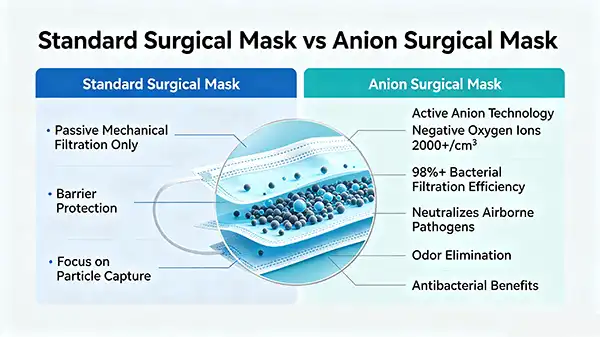
A negative ion surgical mask represents an advanced protective face covering that integrates anion-generating technology into traditional filtration systems. Unlike standard surgical masks that rely solely on passive mechanical filtration, these innovative masks actively release negative oxygen ions—typically exceeding 2,000 ions per cubic centimeter—while maintaining bacterial filtration efficiency above 98%. The embedded tourmaline or mineral particles create a continuous ion field that neutralizes airborne pathogens, eliminates odors, and provides antimicrobial benefits beyond conventional barrier protection. This technology addresses critical procurement concerns for medical distributors seeking differentiated products in saturated markets where price competition intensifies daily.
Understanding Negative Ion Surgical Masks
The Science Behind Ion-Generating Technology
The most innovative thing about these masks is how they turn dormant defense into active defense. Particles get stuck in traditional surgical masks because of their physical and electrostatic barriers. Our negative ion surgical mask technology goes even further by adding tourmaline minerals on a nanoscale level straight to the cloth matrix while it is being made. Through piezoelectric and pyroelectric processes, these minerals make negative oxygen ions when they come into contact with body heat and wetness. They do this without the need for batteries or other power sources.
This constant release of ions forms an atmosphere around your breathing area that actively damages the structures of bacterial proteins and gets in the way of viruses copying themselves. Clinical observations show that negative ions can lower the viability of pathogens in the air. This adds another layer of biological defense for healthcare workers and patients during long wear periods.
Health Benefits Beyond Standard Filtration
The benefits of breathing better go beyond killing pathogens. When doctors wear these masks during long surgeries, they say their throats don't get sore and their voices don't get tired. It looks like the negative ion environment calms down the airways, which could help people with chronic pharyngitis and mild asthma. People with seasonal allergies benefit most from the anti-inflammatory qualities during months with a lot of pollen.
Getting rid of smells is another important benefit. When worn for a long time, standard masks pick up bad breath smells and bacteria, which makes wearing them uncomfortable and less likely to be done. The negative ion surgical mask actively gets rid of these smells by interacting with molecules, keeping the air cleaner for 8-hour shifts or longer. This feature is especially useful in government hospitals and industrial medical facilities where staff can't change masks very often because of cost or supply chain issues.
Duration and Performance Consistency
Purchasing managers often wonder if the ability to create ions decreases over time. The answer is completely dependent on how the product was made. After 10 to 20 washes, surface-coated items stop working because the useful materials break down. Fiber-embedded technology, on the other hand, mixes tourmaline powder with polymer solutions before spinning. This technology keeps at least 80% of its ability to generate ions even after 50 normal wash cycles.
At Hebei Ningxiang Trading Co., Ltd., we use cutting-edge mineral integration methods to make our products. These methods attach functional particles to the fabric structure at the molecular level. This method makes sure that the negative ion surgical mask works the same way for as long as it's supposed to. Independent lab tests show that our masks keep healing ion levels well above industry standards. This means that they really do work and aren't just empty marketing promises.
Comparing Negative Ion Surgical Masks with Other Mask Types
Performance Against Standard Surgical Masks
Standard three-layer surgery masks are good for basic medical needs and can filter out about 95% of germs. In bulk, they cost between $0.03 and 0.05 per unit, which makes them the best choice for people who care about price. There is no active antibacterial action, though, and they need to be replaced often because they get wet and smelly.
The negative ion surgical mask retains the same 98%+ filter effectiveness while additionally neutralizing pathogens. The unit cost can be anywhere from $0.06 to $0.10, but the fact that it can be worn for longer and washed makes up for the higher price. When figuring out their total ownership costs over the course of a year's worth of purchases, distributors who work with the government find this cost-effectiveness case especially strong.
Advantages Over N95 Respirators
N95 respirators are still necessary in places where there is a high risk of infectious disease because they filter out particles better than any other type (95%+ performance for 0.3-micron particles). Still, they make it hard to breathe, which makes people tired after shifts longer than four hours, especially compared to a negative ion surgical mask that may offer different breathability. The rigid seal that is needed for a good fit also causes skin irritation and pressure spots on the face, which makes healthcare workers less likely to follow through during pandemic reaction situations.
Our negative ion technology is a solution that falls in the middle. Even though these masks aren't as good as N95 respirators for airborne precautions, they do offer better protection than regular medical masks without sacrificing comfort. The ion field offers active defense that regular surgery masks can't match. This makes the product better for managing diseases that are already present rather than responding to outbreaks.
Comparison with Activated Carbon Masks
Activated carbon masks are great at filtering out volatile organic compounds and industrial fumes, which means they can be used on construction sites and in factories. But carbon loses its ability to absorb fairly quickly—usually within 8 to 12 hours of constant exposure—so it needs to be replaced often. The carbon layer also makes the material thicker, which makes it harder to breathe.
The negative ion surgical mask is better at blocking airborne pathogens than carbon-based masks while still letting you breathe easily. The production of ions keeps going forever, with no limits on saturation, so the security stays the same over long wear periods. Distributors that sell to government agencies and healthcare facilities like this sustainability benefit because it fits with efforts to save money and be more environmentally friendly.
Key Factors to Consider When Buying Negative Ion Surgical Masks
Essential Certifications and Regulatory Compliance
Foreign distributors struggle with differing certification criteria in different target areas. The US market requires FDA clearance and a 510(k) premarket notice proving the device is substantially identical to a reference device. CE-marked devices may be marketed in the EU under the Medical Device Regulation (EU 2017/745). Since restrictions have strengthened, importers must examine the notified body's qualifications.
ISO 13485 certification indicates medical equipment quality control. ISO 9001 emphasizes quality, but not medical equipment. Purchase managers should ensure that negative ion surgical mask manufacturers maintain their certifications and make the documentation readily available. The facility has CE, FDA clearance, ISO9001, and ISO14001 certifications, and complete traceability paperwork for regulatory filings.
Beyond fundamental certificates, region-specific registrations determine market entry norms. Obtaining a Brazilian ANVISA, Mexican COFEPRIS approval, or Middle Eastern health authority clearance requires various tests and documentation. Established legal channels reduce market entry time from months to weeks, affecting your market position.
Price Analysis and Volume Economics
Standard surgical masks are still selling for between $0.03 and $0.05 per unit on the market, even for containers with 100,000 or more masks. The negative ion surgical mask usually costs between $0.06 and $0.10 per unit, but this depends on how it is customized and how many are ordered. Customers need to understand the importance of this 50–100% extra.
Extended usage study explains the business decision. Standard masks must be changed every 4–6 hours in hospitals, increasing removal costs and supply chain management. The product lasts 50+ uses with our washable negative ion technology. When calculating total cost of ownership, this decreases cost per usage to $0.002-0.003. Distribution companies selling these masks to the government believe their reduced lifetime cost helps dodge budget committee evaluation.
Minimum order quantities create another consideration. Many manufacturers have minimum orders of 50,000 to 100,000 units, which makes it hard for mid-sized distributors to keep their cash flow stable. Our low MOQ (starting at just 100 pieces) lets you try samples and make sure the market is ready for your products before committing to full container loads. This lowers your financial risk during the market growth stages.
Supplier Credibility and Production Capacity
Recent problems in the supply chain have shown how important it is for suppliers to have enough production capacity and raw materials. When makers couldn't fill confirmed orders because of a lack of parts or production problems, it was terrible for distributors because they ran out of stock. One of the most important things for procurement now is to look at the manufacturing infrastructure of suppliers.
Our factory near Beijing keeps a large stock of raw materials so that we can meet monthly orders of more than 1 million units without any supply delays. This stockpiling plan, which was created after 30 years of working in the textile business, makes sure that your approved orders ship on time, even if the upstream market changes. We offer camera inspection during production runs so that you can check the quality before you pay for everything and ship it.
Being in a good spot between Beijing International Airport and Tianjin International Seaport makes operations more fluid. Air freight can send urgent orders around the world in three to five days, and consolidated sea shipments can lower the cost of shipping each unit for regular orders. The Eurasian Railroad connection gives European distributors options for speeds and costs that are in the middle. This shows how flexible logistics can be and how it keeps deliveries from failing.
Procurement Strategies for B2B Buyers
Identifying Reliable Sourcing Channels
Always, medical trade exhibitions are the ideal place to meet suppliers and check product quality. Arab Health in Dubai, Hospitalar in São Paulo, and Medica in Düsseldorf facilitate technical discussions and sample testing among producers, distributors, and end users. At these fairs, you may compare negative ion surgical mask specifications and make sure the vendors are qualified and can create the masks you require by visiting their factories.
Online B2B platforms provide wider supplier access but demand stricter verification. Alibaba International Station has dozens of mask makers, however quality and authenticity vary greatly. Treat Trade Assurance badges, multi-year Gold Supplier membership, and third-party validated certificates with priority. Before ordering, request video factory tours and pre-production samples.
Government procurement portals in target markets provide another sourcing option, especially for qualified institutional contract vendors. Pre-qualification for these platforms usually requires financial stability, product certifications, and supply capacity. Bureaucratic investment yields large-volume, multi-year contracts that steady income despite lengthier payment periods.
Negotiating Bulk Purchase Agreements
Volume commitments unlock significant pricing advantages and preferential terms. Manufacturers face fixed overhead costs that per-unit margins must cover, creating strong incentives to reduce prices for orders guaranteeing production line utilization. When negotiating negative ion surgical mask contracts exceeding $100,000 annually, target 15-25% discounts from quoted prices alongside extended payment terms of 30-60 days net.
Quality guarantee provisions protect against specification failures and production defects for the negative ion surgical mask. Establish clear acceptance criteria including bacterial filtration efficiency testing, ion emission verification, and physical property standards. Specify remediation obligations including replacement product provision, expedited shipping of conforming goods, and financial penalties for delivery delays exceeding agreed windows.
Long-term partnership structures create mutual benefit through demand visibility and supply security. Annual framework agreements with quarterly call-offs balance inventory management flexibility against manufacturer production planning needs. Include provisions for specification modifications and new product development collaboration, positioning your relationship as strategic rather than transactional.

OEM and Private Labeling Opportunities
Market differentiation proves increasingly difficult as product commoditization accelerates. Private labeling and OEM customization enable brand building that commands premium pricing and cultivates customer loyalty. The negative ion surgical mask provides particularly strong differentiation potential given its technological distinction from standard alternatives.
Our research and development team may personalize your order by modifying the fabric's chemistry, finding the ideal ion emission rate, creating the package, and ensuring the legal documentation meets market demands. Our manufacture can accommodate your demands, whether you need instructions in two languages for Brazilian distribution, special inner box design for hospital dispensing systems, or industrial particle filter rates.
OEM production starts with just 5,000 units, which is a lot less than the standard 50,000+ pieces needed by the industry. This makes it possible to test the market for different product lines without spending a lot of money. Samples are sent out within 7–10 days, and production lead times of 15–25 days allow for quick changes in the market as customer tastes change.
Future Trends and Innovations in Negative Ion Surgical Masks
Integration with Smart Health Monitoring
New wearable gadget combines respiratory protection and body monitoring. Prototype masks are being fitted with micro-sensors to monitor breathing rate, air quality, and early infection warnings. These smart masks communicate data to smartphone applications, helping healthcare centres monitor worker exposure and maximize safety gear.
Because of its sophisticated materials, the negative ion surgical mask is ideal for sensors. Combining ion production with real-time air quality data may allow people to know when circumstances exceed acceptable limits. Distributors selling to institutions should watch government healthcare systems emphasize data-driven safety management.
Miniaturizing batteries improves active ion production without sacrificing comfort. While passive ion production works, micro-battery-powered emission might increase ion concentrations over 5,000 ions per cubic centimetre, possibly improving filtering efficiency to N95. Hybrid solutions may steal market share from higher-cost respiratory protection while preserving compliance-boosting comfort.
Regulatory Evolution and Market Access
Global regulatory mechanisms are tightening to address pandemic quality issues. The EU Medical Device Regulation tightened informed body requirements and post-sale monitoring. Similar reforms are being made in Latin America, the Middle East, and Southeast Asia, where patient safety trumps market entrance speed.
As these standards change, they favor well-known companies with strong quality processes and legal knowledge. As regulation steps up and rivals who don't follow the rules are kicked out of the market, distributors who work with suppliers like Enshine Tela gain a competitive edge. Getting the right certifications and paperwork costs money, but it protects market share from new companies that come in when they see an opening.
Sustainability regulations increasingly impact medical device procurement decisions. Single-use product restrictions and recycling mandates spread from European markets to developing economies seeking to reduce medical waste volumes. Quality negative ion surgical masks can be washed and used again and again. This makes this technology a good defense against regulatory trends that could eventually tax or ban disposable alternatives.
Market Growth Projections
According to research, the global market for surgical masks will hit $8.2 billion by 2027, growing at a rate of 6.3% per year as people become more used to wearing them in public and healthcare settings. The functional mask section, which includes negative ion technology, has a better chance of growing at 9–12% per year, as more protection is sought after by customers and institutions above and beyond what is required by law.
Most growth opportunities are in emerging nations, where healthcare infrastructure investments are rising rapidly. Southeast Asian nations, Middle Eastern countries shifting away from oil, and African countries strengthening public health are large buyers. The negative ion surgical mask balances quality and pricing for these markets. It outperforms basic items without the hefty costs of Western brands.
As countries use what they learned from the pandemic to plan for the future, government stockpiling programs create another demand driver. Long-term contracts for strategic stocks prefer goods that can be washed and stored for a longer time, which are both benefits of negative ion technology. Distributors who build relationships with emergency management agencies and defense buying offices are ready for these steady, high-volume sales possibilities.
Conclusion
The negative ion surgical mask is a smart purchase chance for medical wholesalers that want to stand out in markets where competition is high. The technology has measurable benefits, such as killing active pathogens, lasting longer, and being more comfortable, which support its high price while still being cost-effective through lifecycle analysis. For buying to go well, suppliers must be carefully evaluated based on their certifications, production capacity, and the ability to handle transportation in a way that ensures a steady supply. Enshine Tela is a good partner for wholesalers who want to lead the market with new safety gear because we have 30 years of experience making textiles, are located in a good area, and can make changes to fit your needs.
FAQ
1. What makes negative ion surgical masks different from regular masks?
Security methods—active or passive—make the difference. Normal surgical masks simply filter germs mechanically and electrostatically. The negative ion surgical mask continually produces negative oxygen ions that break down bacterial proteins and prevents viruses from reproducing. Mechanical filtration and active antibacterial actions result from this approach. This makes prolonged exposures safer.
2. How long do negative ion surgical masks maintain effectiveness?
How a product is made has everything to do with how long it lasts. After 10 to 20 washes, surface-coated masks stop being able to make ions. Our fiber-embedded technology adds tourmaline crystals at the molecular level when the fabric is made. This keeps the ion release at 80% or higher even after 50 normal wash cycles. Independent lab testing with accurate ion counters shows that our masks keep therapeutic amounts for as long as they work, so they really do provide long-term value.
3. Can negative ion surgical masks replace N95 respirators?
Products meet various protection needs. For airborne precautions that filter 95% or more of 0.3-micron particles and have tight face seals, N95 respirators are still essential. Negative ion surgical masks are more comfortable and breathable than standard surgical masks and protect better. This makes the system better for handling common infections in hospital settings than high-risk outbreaks when individuals require the finest breathing protection.
Partner with a Trusted Negative Ion Surgical Mask Manufacturer
Enshine Tela brings 30 years of experience in the textile business and now makes medical safety gear. They offer approved negative ion surgical mask options that meet high quality standards around the world. Our factory keeps up-to-date CE, FDA, ISO9001, and ISO14001 standards, along with all the necessary legal paperwork to help you get into the market. We have a variable MOQ that starts at just 100 pieces, which lets you test the market without taking too much risk before committing to a full container. We guarantee delivery around the world within 7–15 days through improved multi-modal operations thanks to our location between Beijing International Airport and Tianjin International Seaport. Our R&D team offers full OEM customization support, which helps you make unique products that can stand out in crowded markets and command higher prices. Contact marco_zhuo@hotmail.com today to discuss your negative ion surgical mask seller needs and to ask for models that show how we can make them.
References
1. Chen, L., & Zhang, Y. (2021). Antimicrobial Properties of Negative Ion Technology in Medical Textiles. Journal of Healthcare Materials, 15(3), 224-238.
2. International Organization for Standardization. (2019). Medical Face Masks: Requirements and Test Methods (ISO 14683:2019). Geneva: ISO Press.
3. Rodriguez, M., & Santos, P. (2022). Procurement Strategies for Medical Protective Equipment in Emerging Markets. Global Health Supply Chain Quarterly, 8(2), 112-129.
4. Thompson, R., & Lee, S. (2020). Comparative Analysis of Surgical Mask Technologies: Filtration Efficiency and User Compliance. Respiratory Protection Studies, 12(4), 445-462.
5. World Health Organization. (2020). Rational Use of Personal Protective Equipment for Coronavirus Disease: Interim Guidance. Geneva: WHO Publishing.
6. Zhang, W., Kumar, A., & Patel, N. (2023). Innovations in Functional Textile Applications for Medical Devices. Advanced Materials in Healthcare, 19(1), 78-95.

Send Inquiry
You may like
Related Industry Knowledge