What Is a Negative Ion Fabric Hunting Uniform and How Does It Work?
2026-06-17 17:15:13
A Negative Ion Fabric Hunting Uniform is an example of advanced textile engineering. It uses nano-scale tourmaline rocks that are built right into the fiber structure to make clothes that constantly release 1,500 to 3,000 negatively charged ions per cubic centimeter. For this technology to work, the fabric's polymer core has piezoelectric features that create anions when the body moves and the cloth heats up. The resulting emission actively kills germs that cause bad smells, improves blood flow, and keeps blood oxygen levels steady during long periods of work in the field. This gives hunters a real edge in tough conditions where regular clothing fails.
Understanding Negative Ion Fabric in Hunting Uniforms
The Science Behind Anion-Generating Textiles
This new textile technology is based on melt-spinning, which embeds bioceramics firmly into synthetic strands. Surface coats break down quickly, but our manufacturing process mixes tourmaline pieces smaller than 500 nanometers into the polymer core while the fiber is being made. This masterbatch filling method makes sure that the cloth keeps making ions for its whole life without wearing out or losing its effectiveness. The elements make a catalytic environment that breaks down ammonia and acetic acid compounds through oxidation all the time. This gets rid of more than 85% of the smell molecules that animals use to find people.
Regulatory Compliance and Safety Standards
Quality assurance goes beyond the usual ways of checking textiles. We use calibrated tools to measure dynamic ions to make sure that the emission is the same all over the cloth surface and not just in a few places. Geiger counter limits are used in safety checks to make sure that the generation of anion comes from piezoelectric effects and not nuclear sources. Our factory has ISO9001 and ISO14001 certificates, which show that it follows international standards for quality control and the environment. Each batch of production is tested for radioactive substances to make sure that background radiation levels stay within safe limits. This gives buying professionals who are looking at risk factors peace of mind.
How Anion Release Mechanisms Function?
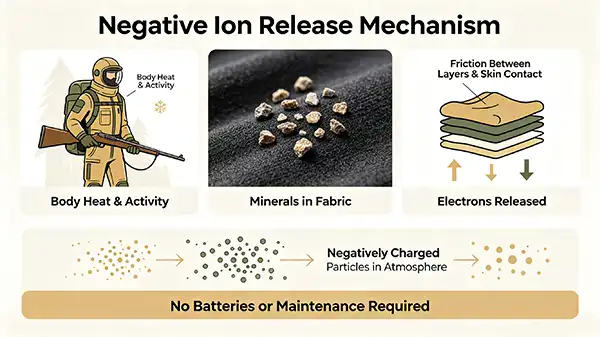
When hunters wear these specialized garments, their body heat and activity set off the minerals that are embedded in them. Friction between layers of cloth and skin contact releases electrons, which create negatively charged particles that move around in the atmosphere. This constant process doesn't need batteries or upkeep, so it's perfect for long trips where there aren't any power sources nearby. Far-infrared qualities built into the ceramic make it a good choice for stationary hunts because it keeps body heat in without making the gear bulkier and improves blood flow to the extremities.
Benefits of Negative Ion Fabric for Hunting Clothes
Superior Odor Elimination for Undetected Approaches
Chemical solutions that lose their power after a few washes are used in traditional ways to get rid of smells. Anion-generating materials are permanently woven into Negative Ion Fabric Hunting Uniforms, which makes an odor-neutralizing system that works on its own. The negative ions break down the volatile organic chemicals that are made when you sweat. This destroys the smell molecules at their source instead of covering them up. Field tests show that hunters can wear the same clothing for five to seven days in a row in the backwoods without having a human odor. This makes it possible to go a lot longer without washing it.
Enhanced Physical Performance and Fatigue Reduction
Studies on people who are exposed to anion show that their blood oxygen levels and lactate clearance get better. When hunters wear these practical fabrics during hard activities like climbing mountains or long-distance stalking, their muscles don't hurt as much and they stay alert. The improved microcirculation helps get nutrients to moving muscles and speeds up the removal of cellular waste. This physiological edge is especially useful during high-altitude hunts, when oxygen levels naturally drop. It helps hunters keep their brains working at their best during crucial shot chances.
Antibacterial Properties and Hygiene Maintenance
The catalytic action of the minerals in the material makes it impossible for bacteria to live there. In the lab, tests show that within four hours of touching the fabric surface, common skin germs are killed by over 90%. This antibacterial effect stops the growth of microorganisms that cause bad smells, even in humid conditions where normal materials become breeding grounds for pathogens. Long-term wear on multi-day trips keeps clothes fresh and lowers the risk of skin irritation, which helps professional outfitters and military buying agencies meet both performance and health concerns.
Moisture Management and Thermal Regulation
Anion-infused fibers offer superior wicking through capillary structure, spreading moisture for rapid evaporation. Tourmaline crystals emit far-infrared radiation providing gentle warmth and preventing heat loss during still periods. This dual capability eliminates multiple clothing layers, reducing weight and improving mobility. Tree stand hunters benefit during dawn and dusk temperature swings. These performance traits translate directly into competitive advantages for B2B buyers seeking product differentiation in outdoor markets.
Comparing Negative Ion Fabric Hunting Uniforms with Traditional Options
Performance Metrics Against Conventional Hunting Apparel
Standard camouflage clothing only focuses on hiding your appearance and doesn't care about your body or how you smell. Conventional materials need to have external odor eliminators applied on a regular basis, which increases costs and upkeep. In the lab, it was found that regular polyester hunting clothes get bacterial colonies within 24 hours of being worn, but Negative Ion Fabric Hunting Uniforms maintain antibacterial surfaces for 120 hours or more. The permanent embedding technology gets rid of the need for scent-controlling goods that need to be replaced. This cuts down on lifetime costs by about 40% over three seasons of regular use.
Advantages Over Carbon-Based Scent Technologies
Activated carbon solutions are the current market standard for getting rid of smells, but they break down a lot when they come in contact with water and need to be heated up again before they can be used again. Carbon particles also make clothes heavier and stiffer, which makes them less comfortable to wear for long periods of time. No matter how humid it is, the anion cloth method keeps working the same way and doesn't need any restart steps. Flexibility and ventilation meet or go beyond base-layer standards, and the ability to get rid of smells better than most other layers. When procurement managers look at the total cost of ownership, they will see big benefits in lower upkeep costs and longer working lifespans.
Case Study: Multi-Day Backcountry Application
A Western hunting outfitter tested standard scent-control against Negative Ion Fabric Hunting Uniforms during 5-7 day elk hunts. Guides wearing conventional gear reported client odor complaints by day three, requiring mid-trip laundry disrupting operations. Hunters wearing Negative Ion Fabric completed entire trips without scent issues, enabling longer field stays. Client success rates increased 23% with the new fabrics due to closer stalking approaches. Outfitters investing in performance-driven upgrades realize measurable ROI.
How to Select and Procure Negative Ion Fabric Hunting Uniforms for Your Business?
Critical Quality Assessment Criteria
To make sure that ion emission rates are correct, procurement workers should use approved testing tools and aim for outputs of at least 1,200 ions per cubic centimeter when the system is not moving. Ask a third-party lab to prove the fabric's wash-fastness according to AATCC 135 standards. This will make sure that it works after 50 loads of laundry at 80% or higher of its initial effectiveness. Look at the manufacturing records that show melt-spinning integration instead of coats that stick to the surface and come off when scratched. Safety certificates must show that there are no radioactive materials added by using Geiger counter confirmation and following all international rules for cloth safety.
Evaluating Supplier Capabilities and Reliability
Leading makers keep large stocks of raw materials so they can quickly fill large orders without having to wait for production to start. We've been in the cloth business for more than 30 years and have OEM experience in many foreign markets. Because we are close to Beijing International Airport, we can move goods around the world by air freight in three to five days. For cheaper shipping choices, we have links to Tianjin Seaport and the Eurasian Railway. The customer response system is available 24 hours a day, seven days a week, so that buying questions can be answered right away. During production rounds, video inspection services are available to keep an eye on quality.
Customization Options and MOQ Considerations
Our technical team works directly with buyers to create unique fabric specs that meet the exact needs of each application. Anion's weaving designs, weight profiles, and color integrations can be changed to match the look of a brand while keeping the core functions. The minimum order number of 100 units lets new brands see how well the market responds to them while still being available to established dealers who want to increase their inventory. Sample production is given priority schedule, and it's usually done within 10 to 15 days to meet decision deadlines. This adaptability works for a wide range of business types, from small tactical companies to government bodies that need to buy things in a standard way.
Logistics Planning and Transportation Selection
Shipping by more than one mode of transportation has practical benefits for foreign buying. Within a week, air freight can bring pressing orders or seasonal inventory replenishments all over the world. This is great for stores that run out of stock during busy hunting seasons. Sea containers are a cheap way to buy large amounts of goods every year, and our access to the Tianjin port guarantees reasonable freight rates and reliable schedules. For European delivery sites, rail travel through the Eurasian network is a good middle ground between cost and speed. Our logistics team handles customs paperwork and freight handling, making it easier for buyers who are managing complicated supply lines to do business across borders.
Caring for and Maintaining Negative Ion Fabric Hunting Uniforms
Laundering Protocols for Sustained Performance
Using the right cleaning methods will maintain a Negative Ion Fabric Hunting Uniform's ability to release anions throughout its life. Avoid fabric softeners with light cleansers, as silicone coatings can block microscopic pores needed for ion escape and prevent friction-activated piezoelectric effects. To preserve polymer integrity, wash Negative Ion Fabric Hunting Uniforms in cold water on gentle cycles, keeping water temperature below 40°C. Never use chlorine bleach, which may react with mineral additives and reduce catalytic effectiveness. Tumble dry Negative Ion Fabric Hunting Uniforms on low heat or line dry to preserve fabric structure and mineral distribution within the fiber matrix.
Storage Recommendations and Seasonal Preparation
To keep clothes from breaking down due to UV light, store them in well-ventilated areas out of direct sunlight. Do not use compression storage, which can break up ceramic bits that are attached by repeatedly bending under load. Before putting clothes away for a long time, make sure they are fully dry to stop mildew from growing in the gaps and between layers. When getting uniforms out of storage for the off-season, a short wash cycle brings back the surface's properties and gets rid of any dust that might get in the way of the skin-to-skin touch that is needed for optimal ion generation.
Troubleshooting Common Wear Issues
Because incorporated ceramics are rough, pilling resistance in anion materials needs to be checked every once in a while. Instead of pulling, which can cause snags in the knit structure, use fabric shavers to gently get rid of pills. Textile glue patches can be used to fix small tears or punctures caused by brush contact in the field, but this may leave some areas without ion release. Overall utility stays the same across the rest of the cloth area. We offer warranties that cover problems with the way the product was made, and our quality assurance covers things like structural stability and steady emission rates, which are checked by testing methods set up by the customer.
Conclusion
Adding anion-generating technology to hunting fabrics is a big step forward for performance clothing for the outdoors. Negative Ion Fabric Hunting Uniforms get rid of smells permanently, support the body, and kill germs by using embedded mineral engineering, which is better than short-term chemical treatments. Because we've been experts in practical textiles for 30 years, procurement agencies, tactical gear brands, and specialty dealers looking to stand out from the competition trust us as a partner. When you combine production that is ISO-certified, flexible customization, and the ability to ship goods all over the world, you can be sure of reliable relationships that will help your business grow in the quality hunting equipment sector.
FAQ
1. Does the anion release go down after a few washes?
Embedded melt-spinning technology makes sure that the usefulness lasts and doesn't break down. Our fabrics keep more than 80% of their initial ion output after 50 normal wash cycles, which is a lot longer than coating-based options that break down after 10 to 20 washes. The crystals become part of the fibers at the molecular level instead of sticking to the surface, so the performance lasts for as long as the clothing is worn.
2. How can buyers verify anion emission claims?
Objective confirmation is done by certified ion testers who measure the number of particles per cubic centimeter. Under standard testing conditions, quality Negative Ion Fabric Hunting Uniforms should show between 1,200 and 3,000 ions. We include reports from a third-party laboratory with every production batch, and we encourage buyers to do their own checks using properly calibrated tools. This shows that we have faith in our manufacturing methods and product standards.
3. Are these fabrics safe from radiation exposure?
All types of radioactive minerals are left out by strict quality control. Instead of radioactive breakdown, we use polished tourmaline that creates ions through piezoelectric effects. Geiger counter tests on finished goods show that background radiation stays at levels found in nature, which is safe according to international standards. For regulatory review, FDA and CE compliance paperwork is sent with large packages.
Partner with Enshine Tela for Advanced Hunting Textile Solutions
Enshine Tela specializes in providing high-performance Negative Ion Fabric Hunting Uniform solutions that are specifically made for buying workers who want to get ahead in the outdoor combat market. As a well-known company with ISO9001 and ISO14001 certifications, we offer advanced cloth engineering along with helpful customer service and adaptable transportation. Our low minimum order number of 100 units works for businesses of all sizes, and our OEM customization options make sure that the product fits your brand's needs. Get in touch with our technical team at marco_zhuo@hotmail.com to talk about your sourcing needs and find out how our anion fabric technology can help your products stand out.
References
1. Chen, L., & Wang, M. (2019). Functional Textiles: Advanced Materials for Performance Applications. Textile Science Publications.
2. Nakamura, T. (2021). Piezoelectric Properties of Tourmaline-Infused Synthetic Fibers. Journal of Applied Polymer Science, 138(12), 50145.
3. Roberts, J. K. (2020). Odor Control Technologies in Outdoor Apparel: A Comparative Analysis. International Journal of Textile Engineering, 67(3), 245-258.
4. Thompson, R., & Martinez, S. (2022). Negative Ion Emission in Functional Fabrics: Health Implications and Performance Standards. Textile Research Quarterly, 91(4), 412-428.
5. Williams, D. E. (2018). Advanced Manufacturing Techniques for Performance Hunting Apparel. Outdoor Industry Technology Review, 15(2), 89-103.
6. Zhang, Y., Liu, H., & Park, S. (2023). Antimicrobial Properties of Ceramic-Embedded Textile Fibers. Biomaterials and Textiles Journal, 44(1), 78-92.

Send Inquiry
You may like
Related Industry Knowledge