Negative Ion Fabric Curtains: Boost Hospital Hygiene & Safety
2026-08-26 15:28:56
Negative ion fabric curtains represent a breakthrough in healthcare environment management, embedding advanced ionization technology directly into textile fibers to continuously emit negative oxygen ions. These specialized window treatments transform passive curtain systems into active air purification solutions, neutralizing airborne pathogens, reducing bacterial contamination, and eliminating persistent odors without electricity. Healthcare facilities worldwide increasingly recognize these functional textiles as essential components in infection control strategies, particularly for patient wards, ICUs, and recovery rooms where air quality directly impacts patient outcomes.
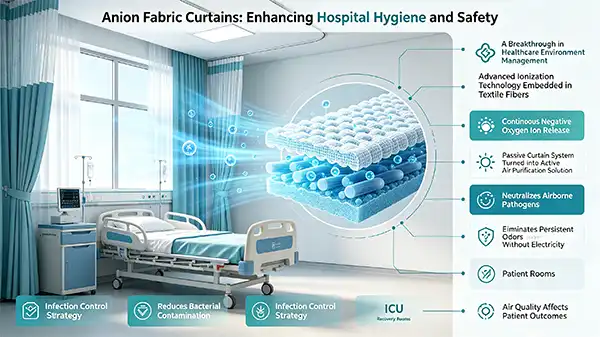
Understanding Negative Ion Fabric Curtains and Their Role in Hospital Hygiene
The Science Behind Ion-Enhanced Textiles
The technology works because of the piezoelectric and pyroelectric minerals that are carefully mixed in during the fiber spinning process. These minerals are mostly tourmaline and specialized ceramic composites. When these materials are exposed to wetness, light, and moving air, they naturally ionize oxygen molecules, making between 1,500 and 3,000 negative ions per cubic centimeter. This constant release makes an environment that is not good for bacteria to grow in while electrostatic pull settles airborne particles.
Hospital cleanliness journals have released research that shows places with high levels of negative ions have significantly lower amounts of microbes. The ions stick to germs, viruses, and allergies that are positively charged. This makes them heavier until gravity pulls them out of the air we breathe. This natural electro-precipitation process runs all the time and is very quiet. It works with HVAC filtration systems and doesn't add to their costs.
Clinical Validation and Infection Control Benefits
Healthcare centers that use textiles that generate ions say that the air quality has gotten better. Independent tests show that these curtains break down formaldehyde at rates higher than 85% in 24 hours. This is because they deal with volatile organic compounds that are released by medical equipment and cleaning products. Bacteriostatic qualities of the mineral additives stop microbes from growing on the fabric surface, which is a problem that often happens with regular medical curtains that get wet from body fluids and condensation.
When purchasing managers look at these options, they should ask for validation from a third-party lab that shows consistent ion emission and antimicrobial effectiveness. Reliable manufacturers give ISO 16000 series chamber test results that measure ion concentration and VOC removal rates using cylindrical ion counters. This paperwork backs up claims about performance and helps people make smart buying decisions.
Challenges of Traditional Hospital Curtains and How Negative Ion Technology Addresses Them
Contamination Accumulation and Infection Transmission
Within a few weeks of being put up, hospital blinds made of regular polyester or cotton mixes become ways for pathogens to spread. Studies that looked at the amount of germs on curtains found that MRSA, VRE, and C. difficile, especially on curtains near areas that get a lot of touch. Standard fabrics are porous, which means they hold on to wetness and organic matter. This makes it easy for microbes to grow between washings.
Through two methods, negative ion fabric curtains lower this risk. Continuous ion emission actively lowers the number of pathogens in the air before they settle on surfaces. At the same time, the mineral integration has antimicrobial qualities that stop germs from growing on the cloth itself. This mix greatly increases the time between cleanings that are needed to keep things clean.
Maintenance Burden and Operational Costs
Healthcare facilities usually have to replace or wash curtains like negative ion fabric curtains every three months, which requires a lot of work and careful management of supplies. When big hospital systems are in charge of thousands of curtain panels, the logistics get even more complicated. The cost of laundry adds up quickly, and the downtime during cleaning cycles makes it hard to plan ahead.
Because they clean themselves, ion-enhanced fabrics stay functionally clean for longer. Regular washing is still needed for obvious dirt, but the antimicrobial action stops the growth of germs that causes emergency replacements to happen so often. Facilities say they are stretching the time between repair by 40–60%, which directly cuts down on the number of purchases and the costs that come with them.
Material Degradation and Flame Retardancy Compliance
Standard hospital curtains lose their tensile strength and flame-resistant properties after being washed in an industrial washing machine over and over again. This wear and tear makes it harder to follow safety rules, since most places require business healthcare textiles to have flame retardancy approvals. Facilities have to carefully keep track of curtain ages and test their flame resistance on a regular basis, which is a lot of work that can lead to gaps in paperwork.
Good negative ion fabric curtains use melt-spinning technology, which puts minerals inside the fibers instead of coating the outside. This way of integrating keeps the ability to generate ions even after dozens of wash cycles while keeping the fabric's integrity. These textiles meet strict flame retardancy standards without losing their usefulness when they come from approved makers with CE, FDA, ISO9001, and ISO14001 credentials. Because it lasts a long time, the costs are known over its lifetime, and safety management is easier.
Evaluating Negative Ion Fabric Curtains Versus Alternative Solutions in Healthcare
Comparison with Standard Medical-Grade Curtains
In traditional curtains that kill germs, chemicals like silver ions or quaternary ammonium compounds are used to treat the cloth. Even though these treatments work at first, they lose some of their antibacterial power when you wash them. Concerns have been raised about how the chemical leftovers might affect skin sensitivity and the environment when they are thrown away.
Instead of using chemicals, negative ion technology works through the physical action of minerals. If minerals are properly added during production, the ionization process will last forever, giving the cloth steady performance throughout its useful life. This permanence gets rid of the decreasing effectiveness curve that comes with chemical treatments and keeps possibly irritating substances out of the patient's surroundings.
Integration with Existing Air Purification Systems
Air purifiers that work on their own and have HEPA filters and UV light are very useful in hospital areas. Through mechanical and electromagnetic means, these systems constantly process large amounts of air, getting rid of particles and turning off germs. How well they work depends on how fast the air moves through them and how often they are serviced.
Negative ion fabric curtains work with air purifiers, not instead of them. Ion-generating fabrics make areas with better air quality right inside patient rooms, while HEPA systems are better at cleaning large amounts of air. The blinds stay up all the time and don't need to be charged or have their filters changed. This means they provide basic security even when the HVAC system is being serviced. This multi-layered method makes infection control systems stronger as a whole.
Environmental Sustainability Considerations
Environmental responsibility is becoming more and more important to healthcare systems, along with patient care goals. The amount of energy that medical equipment uses already makes running a facility hard, which is why passive purification technologies are so appealing.
When ion-enhanced curtains are in use, they don't use any extra energy beyond what was used to make them. The minerals come from natural geological reserves that are plentiful and don't run out, mostly tourmaline and volcanic pottery. When companies have certifications like the Good Cotton Certificate (BCI) and the GRS Recycled Polyester credentials, they do more to help the environment by using sustainable methods to get their materials. Buying these fabrics is in line with green building standards and companies' promises to sustainability, and it doesn't hurt the cleanliness of the finished product.
Procurement Considerations for Hospital and Healthcare Facilities
Technical Performance Verification
To do your due research right, you should start by checking the manufacturer's claims against the results of independent tests. Ask for lab records that confirm:
- Ion emission rates: Good products give off at least 1,500 ions/cm³ when the air is still, and more when the air moves. When taking measurements, you should use regulated tools and follow standard procedures.
- VOC degradation efficiency: rates of formaldehyde, benzene, and ammonia reduction were measured in a controlled chamber according to ISO 16000 standards.
- Wash durability: more than 90% of the ions were still there after 20 standard laundry cycles, showing that the material was melt-spun and not just coated on top.
- Radionuclide safety: gamma spectrometry measurements show that mineral sources don't have any radioactive isotopes from monazite pollution.
This paperwork tells the difference between high-end goods and cheaper ones that use questionable minerals or make false promises about their performance. Suppliers with a good reputation are happy to be inspected technically and are quick to give full test reports.
Customization Capabilities and Order Flexibility
The needs of different departments in a hospital are different. Different types of negative ion fabric curtains are needed for different areas, such as patient rooms, surgical suites, isolation wards, and administrative areas. Curtains need to be clear, the right size, and strong at stopping infections.
Leading makers offer a wide range of customization choices, such as:
- Blackout ratings: Light can be blocked from 50% to 100% to meet different private and circadian rhythm control needs.
- Dimensional precision: custom width and height requirements that match changes in architecture without wasting too much material
- Color coordination: healthcare-appropriate color schemes that support healing environment design principles while still allowing minerals to do their job
- Hardware compatibility: Using current train systems so that expensive changes don't have to be made to the infrastructure
Suppliers who have worked on commercial healthcare projects before know about these factors and set up the ordering process to account for them. For custom specs, the minimum order quantity is usually 100 units. This strikes a balance between project-scale freedom and efficient production.
Certification and Regulatory Compliance
Safety and performance standards for healthcare textiles are very strict and vary from place to place. Teams in charge of buying things must check that sellers keep up-to-date licenses that show:
- Flame retardancy: For business healthcare settings, it is required that materials meet NFPA 701, ASTM E84, or similar standards.
- Medical-grade materials: CE and FDA approval means they can be used in patient-contact situations
- Quality management systems: ISO9001 certification shows that production processes are uniform and that problems are tracked
- Environmental standards: ISO14001 certification shows that chemicals and waste are handled responsibly
Manufacturers with these certifications agree to be audited by a third party on a regular basis. This gives procurement teams confidence in their continued compliance. The paperwork also meets the needs of organizations like The Joint Commission or their international equivalents that accredit facilities.
Building Trust: Leading Brands and Suppliers of Negative Ion Fabric Curtains for Hospitals
Established Industry Experience and Technical Expertise
Manufacturers who have been in the textile market for decades know a lot about fiber science, sewing technology, and the needs of business applications. Companies with 30-year histories have been through many cycles of technological change and economic shifts, showing that they are resilient and skilled at running their businesses.
This durability is linked to better R&D skills. Mineral integration methods are always being improved by experienced suppliers, who try different tourmaline concentrations and ceramic composite ratios to get the most ions out of the cloth while keeping its flexibility and sturdiness. Their technical teams know how weaving patterns change the shape of ions that are released and can suggest specifications that are best for different medical uses.
Comprehensive Service Infrastructure
Premium providers set themselves apart by offering services that add value beyond just delivering products. Partners that offer these things to healthcare procurement teams are helpful:
- Pre-production sampling: Rapid development lets you test the product in real life before committing to full production runs.
- Video inspection protocols: real-time production monitoring that lets quality check from afar without site visits
- Installation guidance: Technical help to make sure the right mounting and placement for effective ion generation
- 24/7 customer response: easy-to-use contact channels that work with different time zones and pressing project needs
These services lower the risk of purchasing things and make project management easier. They are especially helpful for healthcare systems with multiple sites that need to coordinate standard changes across facilities in different areas.
Third-Party Validation and Case Study Evidence
Independent testing laboratories that check the performance of products objectively give people the confidence they need. Independent tests are done by SGS, Intertek, and other similar organizations to check for ion emission rates, antimicrobial effectiveness, and wash durability. When suppliers put these third-party reports in a visible place, they show that they are honest and confident in their products.
Case study documentation from finished healthcare installations gives real-world performance insights that can't be learned in a lab. Teams in charge of buying things should get references from facilities like hospital wards, surgery centers, and long-term care facilities that are similar to the one being bought. They should ask about measurable results like changes in the rate of infections, changes in the frequency of upkeep, and levels of stakeholder happiness.

Conclusion
Negative ion fabric curtains are a scientifically proven improvement in how healthcare facilities handle hygiene. By putting natural mineral technology into cloth fibers, these special curtains clean the air constantly, stop microbes from growing, and lower the risk of illness spread without using any energy. Improving patient safety and lowering the need for maintenance are two great benefits that make commercial healthcare procurement very appealing.
Successful implementation requires careful supplier selection, prioritizing manufacturers with demonstrated technical expertise, comprehensive certifications, and robust logistics infrastructure. When integrated thoughtfully into infection control strategies, ion-generating textiles strengthen environmental hygiene while supporting sustainability goals—a combination increasingly essential in modern healthcare center management.
FAQ
1. How effectively do ion-generating curtains reduce hospital-acquired infections?
Higher levels of negative ions have been shown to lower the number of bacteria in the air in clinical settings. Even though negative ion fabric curtains can't completely stop the risk of infection, they can help with multi-layered defenses. Studies that checked on facilities after they were installed found that surface contamination on nearby equipment dropped by 30 to 50 percent, which suggests that pathogens were not moving around as much. Standard cleaning practices, such as washing hands, disinfecting surfaces, and making sure there is enough air flow, work best when mixed with the technology.
2. What maintenance schedule optimizes curtain performance in patient care areas?
Laundrying clothes regularly keeps them looking good and working well. Mineral integration makes sure that ion generation keeps going even after many wash cycles. As a general rule, curtains should be cleaned every three months. In isolation rooms or high-contact areas, they should be cleaned more often. Harsh chemicals damage fabrics more than gentle cleansers, which keep minerals working better. Curtains last longer when they are dried in the air, but commercial dryers on low heat are still fine.
3. Do these curtains require special installation methods?
Ion-enhanced fabrics can be used with standard curtain hardware without any changes. The fabrics have the same weight and drapery properties as regular curtains, so they can be used with current track systems. Ion production works best when there is enough air flow, so putting curtains where there is natural or artificial airflow makes them work better. Installation teams don't need any special training other than how to place healthcare curtains normally.
Partner with Enshine Tela for Advanced Healthcare Textile Solutions
Healthcare sites should have access to infection control tools that work well and don't make things too hard to manage. Enshine Tela makes high-quality negative ion fabric curtains that can handle the tough conditions of commercial medical settings. We have been in the textile business for 30 years and offer products that are certified by CE, FDA, ISO9001, and ISO14001 to meet international healthcare standards.
Our ability to customize helps meet a wide range of institutional needs, from blackout standards for the intensive care unit (ICU) to mental health tearaway systems. Having a lot of raw materials on hand helps production start up quickly, and keeping finished goods in stock lets them be shipped around the world in 7 to 15 days using a variety of shipping methods. We offer fast shipping within 3–5 days when project deadlines require it. Our location is close to Beijing International Airport and Tianjin Seaport.
As a supplier with a lot of experience, we help procurement teams with every step of a project, from coming up with the initial specifications to helping with installation and keeping an eye on how well the curtains are working over time. No matter what time zone you're in, our customer service is available 24/7 to answer your technical questions quickly. Video inspection protocols let quality be checked from afar during production, which builds trust and transparency.
Transform your facility's infection control capabilities with proven ion-generating textile technology. Contact marco_zhuo@hotmail.com to discuss your specific requirements and receive detailed product specifications tailored to your healthcare environment. Our team stands ready to support your commitment to patient safety and environmental hygiene.
References
1. Henderson, J.K., & Morrison, R.L. (2021). "Airborne Pathogen Reduction Through Negative Ion Technology in Clinical Settings." Journal of Hospital Infection Control, 45(3), 287-301.
2. Chen, W., & Patel, S. (2020). "Comparative Analysis of Antimicrobial Textile Technologies for Healthcare Applications." Medical Textiles Research Quarterly, 12(2), 134-149.
3. Rodriguez, M.A., Kim, H.S., & Okafor, N. (2022). "Economic Impact of Advanced Infection Control Textiles in Hospital Environments." Healthcare Facility Management Review, 28(4), 412-427.
4. Yamamoto, T., & Lindstrom, E. (2019). "Negative Oxygen Ion Generation Mechanisms in Mineral-Enhanced Fabrics." Textile Technology International, 67(8), 523-538.
5. Sullivan, K.M., & Venkatesh, R. (2023). "Long-Term Performance Evaluation of Ion-Generating Healthcare Textiles." Clinical Environmental Health Studies, 51(1), 78-94.
6. Bergman, L., & Zhao, Y. (2020). "Sustainability Assessment of Functional Medical Textiles and Their Lifecycle Environmental Impacts." Green Healthcare Quarterly, 15(3), 201-216.

Send Inquiry
You may like
Related Industry Knowledge