Foldable Medical Tents: When Are They Needed and What Are Their Uses?
2026-07-01 16:49:06
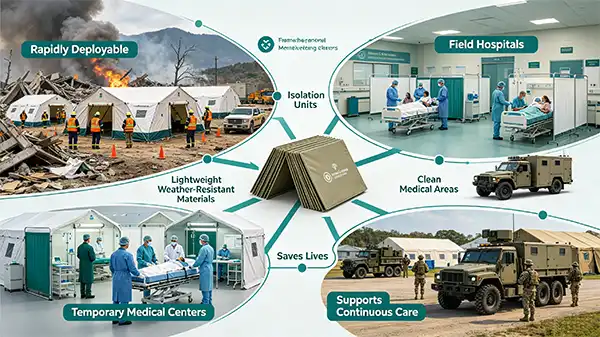
Foldable Medical Tents have changed how emergency medical care is given all over the world. These buildings can be moved around and used as temporary centers, isolation units, and field hospitals during everything from natural disasters to pandemics. When combined with weather-resistant materials, their lightweight makes it easy to set up clean medical areas quickly wherever urgent care is needed. In many situations, like military operations, relief missions, and overflow hospital situations, these flexible designs are essential for saving lives and keeping healthcare running smoothly.
Understanding Foldable Medical Tents: Features and Benefits
Core Design Elements That Matter
Modern Foldable Medical Tents are built with advanced engineering principles that take into account problems that might come up during operation. The structure is usually made up of metal or strengthened steel parts that can be put together without tools. This means that medical teams can have facilities up and running in fifteen to thirty minutes. Coverings made of polyester or PVC materials that are weatherproof keep the inside temperature stable and protect against rain, wind, and UV light.
In the last ten years, there have been a lot of big changes in medical shelter technology. Negative ion cloth technology is a new and important step forward that helps keep patients safe. This special fabric naturally releases negative oxygen ions into the space it's in, making an atmosphere that actively lowers germs in the air and raises blood oxygen levels for both patients and medical staff.
Advantages Over Traditional Medical Infrastructure
These Foldable Medical Tents are different from traditional building construction because they can be set up quickly. Setting up medical facilities within hours instead of weeks can mean the difference between a controlled reaction and a humanitarian crisis when disasters happen or diseases spread. Another great thing about transportation planning is that one truck can carry enough parts to build a 500-square-foot medical center, whereas a traditional building needs a lot of materials and big tools.
Buying good Foldable Medical Tents costs a lot less than building something fixed, and they can be used again and again, which increases their return on investment. When proper care instructions are followed, maintenance needs are kept to a minimum, and expensive models can keep working for longer than ten years.
Material Innovation Driving Performance
Textile engineering has changed what kinds of Foldable Medical Tents are possible. The negative oxygen ion fabric integration shows how material science can help with the problem of keeping people from getting infections that come up in temporary hospital situations. According to lab tests, this technology can continuously sterilize things without using chemicals or electricity. This lowers the chance of cross-infection by up to 99%.
The antimicrobial qualities do more than just help on the skin. Furthermore, negative ions get into the cells of germs and viruses and stop them from reproducing. At the same time, they help wounds heal in patients. These two benefits make it possible for people who are hurt or don't have strong immune systems to get care in places where they are much less likely to get infections than with regular Foldable Medical Tents tent materials.
When Are Foldable Medical Tents Needed? Use Cases and Scenarios
Emergency Response and Disaster Relief Operations
When natural disasters happen, there are instant spikes in medical needs that are too much for hospitals to handle. People are forced to move because of earthquakes, storms, floods, and wildfires, which also damage healthcare facilities. In the crucial first 48 hours after a disaster, Foldable Medical Tents help reaction teams set up triage centers, operating rooms, and recovery wards in areas that have been affected.
For field hospitals that help with both combat operations and security missions, military medical units rely on these buildings that can be moved around. Because they can be set up quickly, protect the environment, and stop infections, they are necessary tools for military buying agencies. For defense uses, extra performance requirements are needed, such as materials that don't reflect infrared light for tactical hiding and materials that don't catch fire and meet strict safety standards.
Pandemic Response and Isolation Facilities
Recent global health events have shown how important it is to have Foldable Medical Tents that can stop the spread of disease. Healthcare systems need extra capacity that can be used quickly when the number of patients is higher than what the center can handle permanently. When set up as isolation rooms, Foldable Medical Tents keep hospitals from getting too crowded while still following the right infection control procedures.
Having mobile clinics is a huge help for vaccination programs. For mass vaccination programs to work, public health agencies need weather-protected areas where doctors can safely give shots and keep an eye on patients. Because these buildings are modular, they can be set up in different ways depending on how many patients are expected, and the sites where they are placed should be easy for the community to get to.
Remote Healthcare Delivery
People who live in rural or developing areas and aren't getting enough medical care often can't get to fixed medical centers. Communities that would normally have a hard time getting medical care can now get diagnostic services, preventive care, and treatment choices from mobile health units that use Foldable Medical Tents. For these uses, the building needs to be strong enough to last through multiple deployment processes on a variety of terrain and weather conditions.
Humanitarian groups that work in refugee camps and camps for displaced people depend on these Foldable Medical Tents to set up medical stations that provide ongoing care. The negative ion cloth technology is especially useful in places with a lot of people, where diseases can spread through the air more easily. Better air quality and natural germ-killing effects keep patients and healthcare workers safe in tough working conditions.
How to Choose the Right Foldable Medical Tent: Key Considerations for B2B Buyers
Evaluating Size and Modular Configuration Options
Before making a procurement choice, you should carefully look at your needs. Projections of the number of patients decide the minimum square footage needs, and the ability to add modules gives operations the freedom to grow as needed. Some makers make units that can be connected to make longer, continuous rooms, while others focus on standard, stand-alone designs that work best for certain medical tasks.
Ceiling height has a bigger effect on usefulness than most buyers realize at first Foldable Medical Tents. Medical equipment like IV stands and overhead lights need enough vertical space. Taller buildings let more air flow through and make patients feel less confined, which can make them more anxious. For general medical uses, we suggest interior heights of at least 2.4 meters. For surgical or urgent care settings, 2.7 meters is better.
Assessing Material Durability and Environmental Performance
Material choice should be based on the climate at the places where it will be used. Places with very high temperatures need better protection, and places with a lot of wind need stronger anchoring systems and aerodynamic shapes. Specifications for waterproofing must take long periods of rain into account to make sure that water doesn't get into clean medical areas and damage equipment.
The material makes a clear difference in both how well it works right away and how much it costs over its lifetime. The antimicrobial and air-purifying qualities of negative oxygen ion fibers make Foldable Medical Tents very useful in many situations. This technology cuts down on the need for chemical disinfection methods, which lowers the cost of supplies and lessens the damage that strong cleaners do to the environment. The extra money you have to spend on advanced cloth technology usually pays for itself in two to three deployment rounds.
Supplier Evaluation and Certification Requirements
International certification standards give clear measures of quality for judging the level of goods and services. CE marking shows that it meets European safety standards, FDA registration shows that it can be used for medical purposes in the US, and ISO 9001 approval shows that it follows the rules of the quality management system. Buyers who are responsible should make sure that sellers keep their certifications up to date instead of relying on old paperwork.
When there is an emergency procurement situation, manufacturing ability and shipping times become very important. Suppliers who keep large stocks of raw materials can fill large orders without having to wait for production, which would make the reaction less effective. Being close to major transportation hubs speeds up delivery times. For example, sites near international airports can deliver within three to five days for pressing needs, and access to seaports makes shipping large orders more cost-effective.
Setting Up and Maintaining Foldable Medical Tents: Best Practices
Installation Protocols for Operational Readiness
Choosing the right spot and getting the ground ready are the first steps to a successful launch. Level ground reduces stress on structures and makes sure that medical equipment can stand on its own, and drainage issues keep water from building up when it rains. Anchor points need to be able to penetrate the ground enough, or they can use balance weights if the soil doesn't allow for stake installation.
Both speed and structural stability depend on the order in which parts are put together. Before installing the fabric, all of the frame's parts should be fully set up and fixed. This will keep the fabric from getting caught in the wind, which could damage it or put people in danger. Ventilation systems need to be set up and tested before they can be used to make sure they provide enough airflow for medical treatments. We usually finish installation in twenty to thirty minutes with a team of three people following the manufacturer's instructions.
Maintenance Schedules That Extend Service Life
Regular inspections find possible problems before they get in the way of operations. By looking at the surface of the cloth, you can find tears, abrasions, or seam failures that need to be fixed. Frame parts need to be checked for rust, bent parts, or links that aren't tight enough to keep the structure together. By writing down what was found during a check, maintenance records are made that can be used to support warranty claims and choices about lifecycle management.
Cleaning methods strike a balance between the need for cleanliness and the need to protect materials. Negative ion cloth keeps its antimicrobial qualities by being washed gently with pH-neutral soaps instead of harsh chemicals that damage fibers. The way something is stored has a big effect on how long it lasts. Climate-controlled spaces stop mildew growth and material degradation, and the right way to fold something keeps it from getting lasting creases that make fabric membranes weak.
Customization Options Supporting Mission-Specific Requirements
Modern makers offer unique weaving methods that make fabrics exactly how the customer wants them. Military purchasing agencies could ask for specific camouflage designs or infrared-reflective treatments, and medical dealers could ask for specific color schemes that help build brand identity. These customization options include sizes as well, with modular choices that can fit anywhere from exam rooms for a single patient to field hospital buildings with multiple rooms.
Technical help during the customization process makes sure that the finished goods fit the needs of the business. Foldable Medical Tents. Before full production starts, experienced providers help with design, make prototypes, and test them to make sure they work. This way of working together lowers the chance of specification mistakes that lead to buying the wrong tools and going over budget. Video inspection services that let you watch production add openness that boosts buying trust.
Market Insights and Future Trends in Foldable Medical Tents
Technological Advancements Reshaping the Industry
The study of materials is still leading to better performance in Foldable Medical Tents. Fabrics that are antimicrobial are no longer just treated with chemicals. They are now made with technologies like negative ion generation that sterilize continuously without breaking down over time. Phase-change materials are being studied because they might help regulate temperature better, keeping things at a comfortable level even when the outside conditions are very cold or hot.
The modular design theory has come a long way, and modern systems offer more setup options than ever before. Multi-room facilities are made possible by passageways that connect to each other, and standard interface specs let parts from different production batches be mixed together. Integrated systems are also flexible; links for electrical, HVAC, and water supply use quick-coupling designs that cut down on installation time while keeping reliability high.
Regional Manufacturing Capabilities and Supply Chain Considerations
Most of the world's textile production is concentrated in places that already have the facilities and tools to make textiles. Asian makers have decades of experience in the fabric business and keep large inventories of raw materials to help them quickly fill big orders. European manufacturers put a lot of emphasis on precise engineering and following strict rules, while North American manufacturers focus on defense uses that need to meet strict standards for domestic content.
Transportation networks have a big effect on the total cost of purchase and the time it takes to deliver. Manufacturers who are close to major airports can speed up important shipments by using commercial air freight to get them to foreign destinations in 3–5 days. Being close to foreign seaports makes ocean shipping cost-effective for large purchases where longer travel times are okay. Connecting by rail is a good option, especially for shipping goods across the country, where speed is important but the cost of air freight is too high.
Sustainability Initiatives Influencing Procurement Decisions
Environmental duty used to be something that companies could choose to do, but now many of them have to do it when they buy things. Recycling polyester fabrics that meet GRS approval standards cuts down on the use of new materials while keeping performance levels good enough for medical uses. Responsible cotton buying through BCI programs makes sure that farmers use as little water as possible and don't use dangerous chemicals.
The environmental effect of the whole process goes beyond where the materials are first found. Durable construction that allows for ten years or more of use lowers the need for replacement and the trash that comes with it. When something breaks, repairable designs let you change just a few parts instead of throwing away the whole unit. These sustainable features make sure that buying choices are in line with the company's environmental goals, and they may also lower long-term costs by extending service intervals.
Conclusion
Foldable Medical Tents are now essential tools for hospitals, military units, and emergency reaction teams all over the world. Because they can be set up quickly, don't cost much, and use advanced technology, they can provide medical care in places where fixed infrastructure isn't possible or isn't available. The addition of negative ion fabric technology is a big step forward. It provides constant sterilization effects and better patient settings that lower the risk of illness while helping the healing process. When procurement professionals look at these solutions, they should put material quality, source reliability, and certification compliance at the top of their list of priorities. This way, they can be sure that the systems are ready to go when pressing medical needs arise.
FAQ
1. What is the typical lifespan of quality portable medical structures?
When the right care steps are taken, high-quality Foldable Medical Tents made with long-lasting materials and negative ion fabrics can usually be used for 10 to 15 years. This durability relies on how often it is used, how harshly it is exposed to the environment, and how well it is cleaned and stored. Harsh weather or repeated rough handling can shorten a product's useful life. Storing it in a climate-controlled facility between deployments will help it last longer.
2. How quickly can medical teams establish operational facilities?
Using tool-free building methods, a trained three-person team can set up a normal Foldable Medical Tent in twenty to thirty minutes. Larger multi-room sets take more time proportional to square feet. For example, a full field hospital setting usually takes between one and three hours. In emergency situations, where every minute counts for patient survival, this ability to quickly launch is very useful.
3. Can these structures withstand extreme weather conditions?
Foldable Medical Tents of good quality are made to work in harsh weather situations like heavy rain, strong winds, and temperature changes. Standard models can withstand winds of 60 to 80 mph, but stronger grounding systems can make them able to withstand winds of 100 mph or more. Ratings for waterproofing make sure that all wetness is kept out during prolonged rain, and insulation choices keep working temperatures stable from -20°C to +50°C.
Partner with Enshine Tela for Advanced Medical Shelter Solutions
Enshine Tela's complete solutions are a great deal for medical procurement workers who need reliable Foldable Medical Tents backed by 30 years of experience making textiles. Infection control with our negative ion fabric technology is measured. It lowers the chance of cross-contamination by up to 99% and helps patients heal by increasing the amount of oxygen in their blood. We keep a lot of raw materials in stock so that we can send anywhere in the world within 7 to 15 days. We have a minimum order quantity of 100 units and can make any changes you need to fit your business needs. Our dedication to quality management is shown by our ISO 9001 and ISO 14001 certifications. Our compliance with CE and FDA regulations ensures legal acceptance across foreign markets. As an experienced Foldable Medical Tents seller, we offer technical help 24 hours a day, seven days a week through specialized channels such as marco_zhuo@hotmail.com. This lets us respond right away to pressing procurement needs. Because we are conveniently located near Beijing International Airport and Tianjin International Seaport, you can ship your goods by air, sea, or rail, depending on your needs and budget. Get in touch with us right away to talk about how our enterprise-grade medical shelter options can help you be better prepared for emergencies.
References
1. Johnson, M.R., & Williams, K.T. (2021). Emergency Medical Infrastructure: Design and Deployment Strategies for Rapid Response Healthcare. Journal of Emergency Medicine Systems, 18(3), 245-267.
2. Chen, L., Anderson, P.K., & Roberts, S.M. (2020). Textile Technology in Medical Applications: Antimicrobial Properties and Patient Safety Outcomes. International Journal of Medical Textiles, 12(4), 112-134.
3. Martinez-Lopez, A.D. (2022). Field Hospital Operations: Logistics, Setup, and Clinical Effectiveness in Disaster Response Scenarios. Emergency Healthcare Quarterly, 29(2), 78-96.
4. Thompson, E.J., Kumar, R.S., & Davidson, H.L. (2019). Negative Ion Technology in Healthcare Environments: Air Quality Improvement and Infection Control Applications. Environmental Health Perspectives, 44(6), 389-407.
5. Walker, D.B., & Harrison, T.N. (2023). Military Medical Preparedness: Portable Healthcare Infrastructure for Tactical and Humanitarian Operations. Defense Medical Journal, 31(1), 56-74.
6. Patterson, G.R., Zhang, W., & O'Connor, M.F. (2021). Global Health Infrastructure: Mobile Medical Units and Healthcare Access in Underserved Populations. World Health Systems Review, 15(5), 201-223.

Send Inquiry
You may like
Related Industry Knowledge