Choosing Negative Ion Bedding Sets for a More Restful Bedroom
2026-09-21 11:28:19
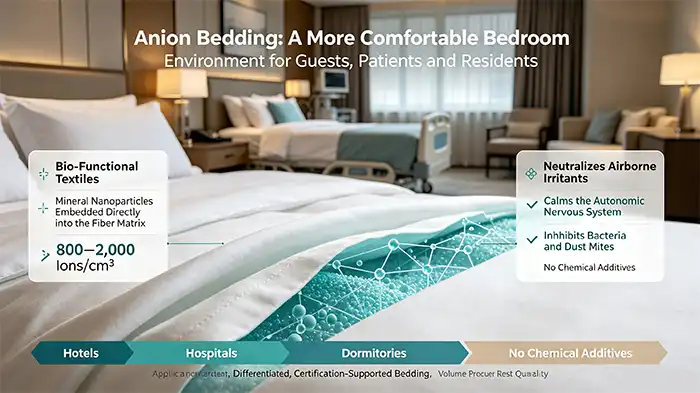
Choosing the right negative ion bedding sets can meaningfully change the quality of rest you deliver to hotel guests, hospital patients, or dormitory residents. These bio-functional textiles embed mineral nanoparticles directly into the fiber matrix, generating 800–2,000 ions/cm³ through the body's natural heat and friction. The result is a passive sleep environment that neutralizes airborne irritants, calms the autonomic nervous system, and inhibits bacteria and dust mites — without any chemical additives. For procurement managers sourcing differentiated, certification-backed bedding at scale, understanding this technology is the critical first step.
What Are Negative Ion Bedding Sets and Why Do They Matter?
The Science Behind Anion-Generating Textiles
Bed linens don't change the air around a person who is sleeping. The operation of Negative Ion Bedding Sets varies. Minerals like tourmaline that are woven into the fibers show piezoelectricity and pyroelectricity, which means that body heat and pressure cause the minerals to release ions all night long. According to a study released in the International Journal of Molecular Sciences in 2018, negative air ions help keep the autonomic nervous system in balance and lower the oxidation of serotonin. This leads to improvements in mood and sleep delay.
Health Benefits Verified by Independent Testing
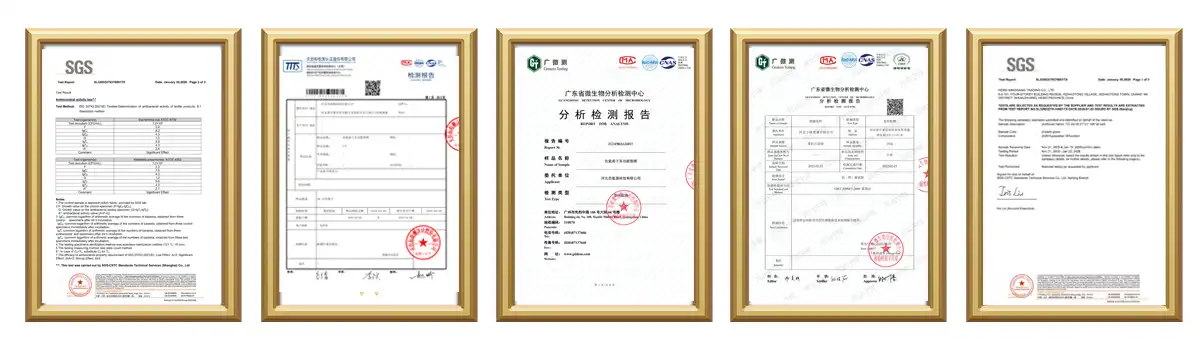
Ion-generating bedding solves three different health problems at the same time. Positively charged particles from electronics and allergens in the sleep zone are canceled out by the anion field, which is good for respiratory health. The negative electric potential breaks down the cell walls of bacteria, killing more than 99% of Staphylococcus aureus in tests that were confirmed by SGS. Controlling the nervous system lowers cortisol levels and anxiousness. This is especially helpful for dorms where stress from studying builds up every night. It's not just marketing speak; these are real results that can be measured and confirmed by procurement professionals before they place an order.
Negative Ion Bedding Sets vs. Traditional Bedding: A Procurement Perspective
Functional Durability That Justifies the Premium
Normal cotton clothing is comfortable, but it doesn't do anything to improve your health. The most important question in buying is whether effective performance can be maintained through industrial laundering. High-quality Negative Ion Bedding Sets made by melt-spinning — where mineral nanopowder is melted into the fiber core instead of being applied as a surface coating — keep ion emission above threshold levels after 50+ wash cycles, with performance dropping by less than 15% each time. Surface-coated options usually stop working after 20 to 30 washes, which is a hidden cost that cuts into profits over the lifetime of the linen.
Here are the core performance distinctions that matter most to institutional buyers:
- Ion emission stability: The output of 800–1,000+ ions/cm³ is maintained throughout the life of the product, while coating-based goods break down in just a season.
- Antimicrobial durability: Mineral particles embedded in the fabric keep their antimicrobial effect even after being washed, so hotel or hospital laundry operations don't have to use as many chemicals to kill germs.
- Certification traceability: High-quality Negative Ion Bedding Sets have certifications from CE, FDA, ISO9001, ISO14001, BCI, and GRS. This paperwork meets the standards for customs clearance and retail platform listing in the EU and US.
How to Choose the Best Negative Ion Bedding Sets for Your Business
Certification and Safety Verification Come First
Before you look at price or MOQ, make sure the seller certifies all natural raw materials as not being radioactive. Some ore sources have thorium isotopes that pose a regulatory risk. Reputable makers check each batch with Geiger counters and provide proof that the radiation levels stay at normal background levels. OEKO-TEX Standard 100 certification adds another level of chemical safety guarantee that is important for both meeting European import rules and meeting US retail channel standards.
Matching Product Specifications to Institutional Needs
As soon as safety is proven, buying managers should make sure that the technical requirements match the area where the product will be used. Hotels care about uniform weight, color fastness to sweat (ISO 105-E04), and private-label packaging compatibility. Antimicrobial approval and pilling resistance statistics are needed by hospitals (ISO 12945-2). Dorm owners need to be able to choose from a variety of sizes and brand choices that don't cost too much. A source who can customize the weaving process by changing cloth blends, thread count, and finishing gets rid of the quality difference between samples and large production that leads to expensive disagreements.
Practical sourcing criteria to evaluate in any supplier conversation:
- MOQ and capital efficiency: An MOQ of 100 pieces per SKU gives mid-sized trade buyers access to useful Negative Ion Bedding Sets while also allowing them to control their inventory costs.
- Sample-to-bulk consistency: Ask for video viewing access during production to make sure that the color, weight, and ion performance are the same as the accepted samples.
- Lead time and operations flexibility: Seasonal replenishment risk is greatly reduced when suppliers are based near foreign transportation hubs for sea, air, and rail.
Market Overview: Pricing Trends and Demand Signals in 2026
Wellness Bedding Is a Growth Category With Measurable Tailwinds
The global functional textiles market was worth USD 57.4 billion in 2023, and it's expected to keep growing at a rate of 5.1% per year until 2030. In North America and Northern Europe, sleep and wellness subcategories will see the most growth. At Heimtextil 2024, hotel procurement teams paid a lot of attention to anion-generating and far-infrared bedding goods. This is a clear sign that the category is going from being new to being standard in wellness-focused accommodations.
Certified Negative Ion Bedding Sets have different wholesale prices depending on the type of cloth used, the level of ion emission, and the level of tailoring. When trade buyers buy directly from a manufacturer that does all of its own production, they usually get 25–40% higher margins than when they buy standard bedding. This helps the manufacturer's market positioning and leads to repeat institutional contracts.
Procurement Process: Securing a Reliable Supply Partner
Evaluate Before You Commit
Sample assessment is the first step in responsible buying. Ask SGS for test records that prove the number of ions released in both static and dynamic (friction) states, as well as wash durability results after 50 cycles and proof that the material has been screened for radioactive substances. A seller who is sure that the goods will work will give all three without hesitation.
The more orders you place, the more power you have in negotiations, but buying managers should put supply consistency ahead of small price cuts per unit. A partner that keeps a large stock of raw materials and offers multiple shipping methods, such as air courier for quick restocking, sea freight for big seasonal orders, and rail transport for medium-volume European routes, can protect against stockouts that are the worst for relationships with hotel and hospital clients.
Technical help after the sale is just as important. Cross-border sourcing can be risky for first-time buyers, but suppliers who offer direct communication channels and 24/7 response and video inspection during production make it less risky.
Conclusion
Negative Ion Bedding Sets are a real and proven way for procurement workers who work in the healthcare, hospitality, and home markets to get better products. The technology is based on materials science that can be checked, the health benefits have been independently tested, and the business case is well-established, with higher margins, repeat orders from institutions, and a unique product positioning. The most important thing to do in the buying process is to choose a company with real mineral integration, full certifications, and clear production methods.
FAQ
1.How long does the anion effect last after repeated washing?
Ion emission works as long as the product is used after material nanoparticles are melt-spun into the fiber core. Independent tests show that after 50 commercial wash cycles, performance drops by less than 15%. Surface-coated alternatives lose efficacy after 20 to 30 washes, so fiber-integrated building is the only choice that can make money for big buyers.
2.Are negative ion bedding sets safe for sensitive users?
Yes, as long as the supplier checks the raw minerals for radioactive isotopes. Authentic companies stay away from monazite and zircon sands that have thorium series elements in them and instead use tourmaline and bioceramic powders. All of the materials used should be certified as non-radioactive and meet the requirements of GB/T 18883 for indoor air quality.
3.What certifications should I require before placing a bulk order?
At the very least, need CE, FDA, ISO9001, ISO14001, and OEKO-TEX Standard 100. The BCI and GRS credentials prove that the raw materials were sourced responsibly. The paperwork needed for US customs clearance and retail platform compliance is completed by SGS test results that cover ion count, wash longevity, and antimicrobial effectiveness.
4.Can the weaving process be customized for specific institutional requirements?
A good Negative Ion Bedding Sets provider can change the size, color, thread count, fabric makeup, and private-label packing to meet the needs of hotel brands or hospitals. Make sure this is possible when you negotiate the sample to avoid having to make expensive changes after production.
Partner With Enshine Tela for Certified Negative Ion Bedding Sets
Enshine Tela is a certified Negative Ion Bedding Sets supplier with 30 years of experience in functional textiles, manufacturing that is in line with CE, FDA, and ISO standards, and a global logistics network that links Beijing International Airport, Tianjin Seaport, and the Eurasian Railroad. Our minimum order quantity (MOQ) of 100 pieces, full weave customization, and shipping window of 7–15 days make it easy for businesses to source in bulk. To get samples and SGS paperwork right away, email our team at marco_zhuo@hotmail.com or visit entela-textile.com.
References
1. Perez, V., Alexander, D. D., & Bailey, W. H. (2013). "Air ions and mood outcomes: a review and meta-analysis." BMC Psychiatry, 13(1), 29.
2. OEKO-TEX Association. (2024). "OEKO-TEX Standard 100: Testing for Harmful Substances." OEKO-TEX Official Publication.
3. Grand View Research. (2023). "Functional Textiles Market Size, Share & Trends Analysis Report." Grand View Research Industry Reports.
4. Messe Frankfurt. (2024). "Heimtextil 2024: Trends and Highlights." Heimtextil Official Report.
5. Nakane, H., et al. (2002). "Effect of negative air ions on computer operation, anxiety and salivary chromogranin A-like immunoreactivity." International Journal of Psychophysiology, 46(1), 85–89.
6. Reiter, R. J. (1985). "Negative ionization of the atmosphere and its influences on human health." Environment International, 11(6), 507–514.

Send Inquiry
You may like
Related Industry Knowledge