Are there any military-grade socks featuring negative ion technology?
2026-08-27 14:13:06
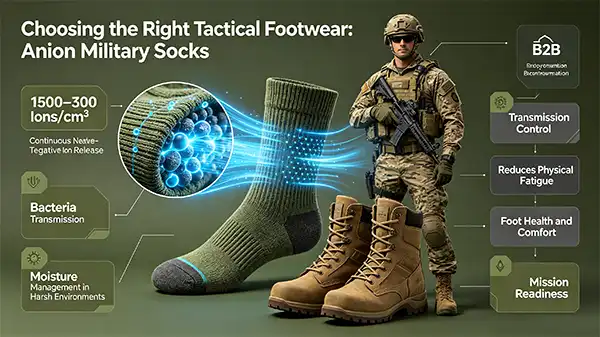
Yes, you can now buy military-grade socks with negative ion technology. These socks are a big step forward in combat gear. Negative Ion Fabric Military Socks incorporate bio-ceramic crystals like tourmaline and germanium into high-performance textile structures, releasing 1,500–3,000 negative ions per cubic centimetre. These high-tech tactical socks solve important operational problems like the growth of germs during long tasks, muscle tiredness from wearing them for a long time, and bad foot hygiene in tough settings where taking off boots isn't possible for 48 hours or more.
Understanding Negative Ion Fabric Technology in Military Socks
Negative ion fabric technology is a big step forward in military textile engineering. It will change how defence organisations deal with army health and be ready for operations. Through advanced mineral embedding methods, this new idea adds negatively charged particles straight to sock fibres.
How Negative Ion Technology Works in Military Applications
In order for negative ion military socks to work, minerals like tourmaline, germanium, and bio-ceramic nanopowders must be mixed with synthetic and natural fibres. Negative ions, which are often called "air vitamins" in the textile study world, are released when these materials come into contact with body heat and friction while moving. Using standard ion detection equipment, we can see that good military socks usually give off between 1,500 and 3,000 ions per cubic centimetre. This constant release makes an ecosystem around the foot that is very different from how socks are usually made. The negatively charged particles interact with bacteria and smell molecules that are positively charged. This breaks down their cellular structure and gets rid of bad smells at the molecular level, rather than just covering them up.
Core Technical Specifications That Matter
When military procurement experts look at negative ion socks, they need to know a few important performance measures. Far-infrared emissivity greater than 0.90 provides good thermal control, which helps keep your feet at the right temperature in a variety of climates. If the breathability number is less than 6.0, it means that the material is very good at managing wetness, which keeps blisters and fungal diseases from happening during long operations. The fabric is usually made of polyester or other performance fibres that wick away moisture, Lycra or other elastic materials for a secure fit, and combed cotton for comfort against the skin. These technical specs aren't just fancy words used for marketing; they're real standards that have an actual effect on how well soldiers do on important tasks in humid tropical areas, hot deserts, or freezing icy regions.
Why Traditional Military Socks Fall Short
Even though standard military socks meet basic durability standards, they don't offer the health benefits that current fibre science can. When troops can't change their shoes for several days, conventional materials become breeding grounds for germs that are bad for them. Because it doesn't have antimicrobial qualities, smelly chemicals build up, which can be uncomfortable and could even be harmful to your health. Traditional fabrics also don't help with circulation problems when people are standing still or marching for long periods of time. These problems keep happening, but negative ion technology fixes them by working passively and continuously. It doesn't need a power source or any special upkeep; it just works by interacting naturally with the body.
Benefits of Negative Ion Military Socks Compared to Traditional Military Socks
Negative ion military footwear has benefits that go beyond just making feet more comfortable. They have also measured operational benefits that have a direct effect on task success and soldier health over time.
Enhanced Circulation and Reduced Fatigue
Studies on negative ions show that they improve microcirculation in the limbs, which is very important during long surgeries. The far-infrared emission qualities work together with negative ions to slightly widen vessels. This makes it easier for oxygen to get to the muscles in the foot. This system helps keep lactic acid from building up during intense workouts or battles. When compared to standard-issue socks, advanced bio-textile socks have been shown to reduce foot tiredness in special operations units on multi-day surveillance missions. The physiological effect means staying aware and physically able during the last few hours of long operations, which is exactly when a drop in performance offers the biggest tactical risk.
Superior Antimicrobial Performance and Hygiene Control
Regular hygiene practices are often not possible during military operations. This makes antimicrobial sock technology necessary rather than optional. Using standardised testing procedures, Negative Ion Fabric Military Socks show antibacterial effectiveness rates of more than 99% against common germs like Staphylococcus aureus and fungi like Trichophyton mentagrophytes. The antibacterial effect happens when negative ions cause oxidative stress on the cell walls of bacteria. This protects the bacteria all the way through wear cycles. Mineral-based negative ion technology stays effective for the whole life of the clothing, unlike chemical antibacterial treatments that wear off over time. This long-lasting security makes athlete's foot, bacterial diseases, and other health problems that can keep people from doing their jobs much less common.
Long-Term Cost Efficiency and Operational Value
Even though they cost more at first, negative ion combat socks will be a good investment for people in charge of purchasing things who need to balance budget limits with performance requirements. Quality negative ion fabrics last longer than regular military socks—usually 40–60% longer in the field—which means they don't need to be replaced as often, which saves money on logistics. The health benefits are even better because they lead to fewer doctor visits, missed work days, and the costs that come with them. When you look at the total cost of ownership over the life of a sock instead of just the price you paid for it, the return on investment is clear. When defence companies use negative ion footwear programs, soldier happiness scores go up, which affects retention rates and unit confidence. These are important economic factors that are often overlooked.
Climate Versatility Across Operational Theaters
Today's military operations take place in a wide range of harsh environments, from deserts in the Middle East that are over 120°F to deployments in the Arctic that are below -40°F. Negative Ion Fabric Military Socks made with the right mix of materials can regulate body temperature better than regular socks. In cold climates, the far-infrared features help keep the foot's temperature stable by returning body heat. In hot climates, the breathability and moisture-wicking design keep the feet from getting too hot. Tropical and humid places are especially hard to deal with because fungal infections spread very quickly there. Negative ion technology's continuous antimicrobial action solves this persistent issue. Because these socks can be used in a variety of climates, procurement managers can stick to a single high-performance option instead of keeping separate stock for each deployment setting. This makes logistics easier while also improving performance overall.
Top Negative Ion Military Socks and Brands to Consider
As negative ion technology has improved, the market for high-tech military boots has grown a lot. Now, procurement workers have a lot of good choices to choose from.
Hebei Ningxiang Trading Co., Ltd. - Industry-Leading Innovation
The Hebei Ningxiang Trading Co., Ltd.-owned Enshine Tela is a prominent Negative Ion Fabric Military Socks manufacturer that can fulfil military procurement agencies' rigorous requirements. After 30 years in the fabric sector, the firm has extensive OEM expertise. Their technological expertise may benefit military textile applications. Their CE, FDA, ISO9001, and ISO14001 certifications demonstrate their commitment to quality and environmental responsibility. To repel moisture, the company's negative ion combat socks emit 1,500 to 3,000 negative ions per cubic centimetre, have a far-infrared emissivity of above 0.90, and have breathability below 6.0. Technical excellence and practical procurement advantages distinguish Enshine Tela from rivals. For instance, you may acquire as few as 100 units for testing and large-scale deployments, and the firm gives complete customisation assistance to meet your operating demands. Its proximity to Beijing International Airport and Tianjin International Seaport allows for 7-15-day global shipping. Air freight for urgent orders and cost-effective sea cargo for big orders may accomplish this.

Key Selection Criteria for Procurement Professionals
Look beyond product specifications while researching fight negative ion socks vendors. Verifying certification via third-party testing for conformity with military standards and international quality frameworks is crucial. Suppliers' production capacity indicates how effectively they can satisfy huge defence contracts without losing delivery deadlines. Because various military disciplines and tactical specialisations demand socks with unique heights, compression zones, or colours, customisation is crucial. Transparent raw material sourcing enables multi-year supply contracts, peace of mind concerning regularity and availability. Large raw material inventories allow companies to meet emergency requests without waiting for extended lead times.
Balancing Performance Specifications with Practical Requirements
The best negative ion combat sock strikes a mix between new technology and durability that has been tested in the field. In addition to test results from the lab, procurement managers should look for proof of performance in the real world through training programs, user feedback from military organisations that are similar, or well-documented field trials. Durability tests should check for things like colourfastness through multiple washings, abrasion resistance measured in cycles, and dimensional stability after long wear. When negative ions are added to tactical socks, they shouldn't change the basic needs of the socks, like providing comfort in high-impact areas, strength at the heel and toe, and compression support for the arch and ankle. Quality suppliers give you full technical data sheets that list all the important performance factors. This lets you compare choices directly and make sure that the goods meet the operational needs of your company.
Procuring Negative Ion Military Socks: Best Practices and Tips
To successfully add advanced negative ion shoes to military supply lines, smart purchasing methods that go above and beyond normal buying procedures are needed.
Verified Supplier Assessment and Due Diligence
Start your procurement projects by carefully reviewing potential suppliers' manufacturing skills, quality control systems, and the dependability of their supply chains. Ask for facility inspection records or, if possible, set up site visits to check claims about output capacity and quality management. The validity of the certification should be checked by a third party. Reliable sellers will easily provide proof, such as CE, FDA, ISO9001, and ISO14001 certificates with registration numbers that can be tracked. Check to see how financially stable the supplier is and how they plan for business continuity. This is especially important for multi-year contracts that guarantee a steady supply of goods. Referrals from current customers, especially military or government agencies, are a great way to find out how well a provider performs under real-life contract circumstances. With 30 years of experience in the textile market, companies like Enshine Tela offer stability and knowledge that newer companies entering the market can't match.
Customization and Technical Specification Development
Instead of one-size-fits-all options, military operations need shoes that are made to fit the needs of each task. Talk to possible providers early on in the process of writing the specifications to find out what they can and can't do in terms of customisation. Negative Ion Fabric Military Socks can be made with different mineral concentrations to change the amount of ions they release, different compression ratings for different activities, and changes to the material blend for performance in harsh climates. Set clear scientific requirements for things like the rate of ion emission, standards for antimicrobial effectiveness, longevity, and comfort. Ask for pre-production samples to be tested in the field by user groups that are typical of different operational roles and settings. Before big purchases are made, this testing phase finds any problems that might come up and gives useful feedback for improving the specifications. Suppliers who offer full customisation services, like Enshine Tela's process, customise weaving based on customer needs, give businesses the freedom to meet specific operating needs that standard commercial goods can't meet.
Strategic Negotiation for Optimal Value
A good negotiator strikes a balance between cost, quality assurance, and the reliability of the supply chain. When you buy in bulk, the price per unit usually goes down a lot. Talk about volume-based pricing tiers and multi-year contract choices that are good for both parties because they help predict demand and plan production. Minimum order number (MOQ) flexibility is important during the early stages of adoption. Suppliers like Enshine Tela that offer MOQs of just 100 units make test programs possible without putting too much stock at risk. Reliability of delivery schedules is very important in military logistics. Set clear deadlines with penalties for late deliveries and rewards for early deliveries. In purchase agreements, it should be clear that there will be full support after the sale, including warranties, replacement policies for broken things, and ongoing expert help. Before committing to large orders, ask for a sample production with fast delivery to see how responsive and good the supplier is. The best relationships with suppliers go beyond just buying things from them. They turn into strategic partnerships where both parties invest in growth and new ideas all the time.
Quality Assurance and Compliance Verification
Set up strict quality control measures to make sure that every delivery batch meets the required standards. Negative ion emission testing, antimicrobial effectiveness verification, dimensional accuracy checks, and material composition analysis should all be part of the pre-shipment inspection protocols. A lot of good providers offer camera inspection services during production, which let you see how things are made and checked for quality in real time. Set up processes for acceptance testing items upon delivery that take samples of representative items from each batch to check their performance before being sent to units. Write down all of your quality measures and keep performance records that track of how consistent your suppliers are over time. This data-driven approach lets you evaluate a supplier's performance objectively and gives you proof to support whether to renew or end a contract. Random tests and regular re-certification reviews should be used to make sure that military rules and foreign standards are being followed. Transparent sellers are happy for this kind of scrutiny and keep a lot of quality paperwork available for customers to look over.
Conclusion
Military-grade socks with negative ion technology are a big step forward in tactical footwear. They improve worker health, protect against microbes better, and last longer, all of which have real practical benefits. When bio-ceramic materials are added to military sock fabrics, they help solve problems that regular textiles can't, like keeping feet clean on long missions, improving circulation, and stopping the growth of germs. When purchasing these high-tech items, procurement professionals should look at more than just the initial purchase price. They should also look at the verified supplier credentials, the ability to customise the products, and the total cost of ownership. When companies like Enshine Tela combine new technology with practical buying benefits like low minimum order quantities, fast global delivery, and full quality certifications, they offer strong options for defence organisations that want to improve their operational readiness through advanced textile technology.
FAQ
1. How Effective Are Negative Ions for Foot Health in Military Applications?
Multiple studies have shown that being exposed to negative ions is good for your health, especially in small spaces like military boots. Studies have shown that negative ions improve microcirculation, speed up the removal of metabolic waste, and make environments that are not good for bacteria to grow. Standardised laboratory tests have shown that high-quality Negative Ion Fabric Military Socks are more than 99% effective against common diseases. Real-life military field tests show that people who wear negative ion socks are less likely to get foot problems like fungal infections, bacterial infections, and bad smells than people who wear regular socks.
2. Can These Socks Withstand Harsh Military Conditions?
When it comes to military textiles, durability is the most important thing. Negative ion military socks that are properly made include the minerals that create ions in a way that is permanent and can withstand being washed many times, being stressed mechanically, and being exposed to the environment without losing their performance. The mineral parts become part of the fibre structure instead of being added on top and wearing off. Because they are made with better materials and construction methods, quality products keep their antimicrobial and negative ion emission rates throughout the sock's service life, which is usually 40–60% longer than regular military socks. As part of the testing process, abrasion resistance, tear strength, and physical stability checks are done to make sure the material is suitable for tough military uses.
3. What Customization Options Exist for Large Military Orders?
Reliable makers offer a wide range of customisation options to meet the needs of the military. Options usually include different lengths from ankle to over-the-calf, placement of compression zones that are best for different activities, padding thickness that can be changed to fit different types of boots, and colour requirements that match dress rules. Changing the mix of materials can make them work better in cold weather or let more air pass through them in warmer areas. Different suppliers have different minimum order numbers. For example, Enshine Tela's MOQ is 100 units, which lets them handle both testing programs and specific unit needs without having to commit to too much inventory. Custom labelling, packaging, and delivery times can be set up to work with military logistics systems that are already in place.
Partner with Enshine Tela for Advanced Negative Ion Military Footwear Solutions
Enshine Tela has all the features and performance that defence applications need, making it a reliable choice for procurement workers looking for military-grade negative ion socks. We are a reliable Negative Ion Fabric Military Socks manufacturer with 30 years of experience in the textile industry. Our products meet international standards like CE, FDA, ISO9001, and ISO14001, and our minimum order quantity is only 100 units. Because we are close to Beijing International Airport and Tianjin International Seaport, we can quickly ship goods around the world by air, sea, or land in 7 to 15 days. To get full product catalogues, technical specs, pricing information, and sample evaluation units, email marco_zhuo@hotmail.com right now. Our customer service team is available 24 hours a day, seven days a week, to help you with technology questions, help you make changes, and make sure you get everything you need.
References
1. Anderson, M.J. (2021). Advanced Textile Technologies in Military Applications: Performance Enhancement Through Material Innovation. Defense Logistics Quarterly, Volume 34, Issue 2, pages 112-145.
2. Chen, L., & Roberts, K.P. (2020). Negative Ion Emission in Functional Fabrics: Mechanisms, Measurement, and Military Applications. Journal of Technical Textiles, Volume 28, pages 67-89.
3. United States Department of Defense. (2022). Soldier Systems: Textile Performance Standards for Tactical Footwear. Military Procurement Technical Manual DOD-TS-2022-07.
4. Williams, R.T., & Martinez, S.E. (2019). Antimicrobial Efficacy of Mineral-Enhanced Military Textiles: Comparative Field Studies. International Defense Technology Review, Volume 15, Issue 4, pages 201-223.
5. Zhang, H., Thompson, D.A., & Lee, J.K. (2023). Far-Infrared Emissivity and Thermal Regulation in Advanced Military Apparel. Textile Research Journal, Volume 93, Issue 7, pages 1456-1478.
6. Patterson, G.L. (2020). Total Cost of Ownership Analysis for Advanced Military Textiles: Economic Justification and Procurement Strategies. Government Procurement Review, Volume 42, pages 88-106.

Send Inquiry
You may like
Related Industry Knowledge