Anion Placemat Guide: Materials, Features, and Benefits
2026-09-21 11:39:09
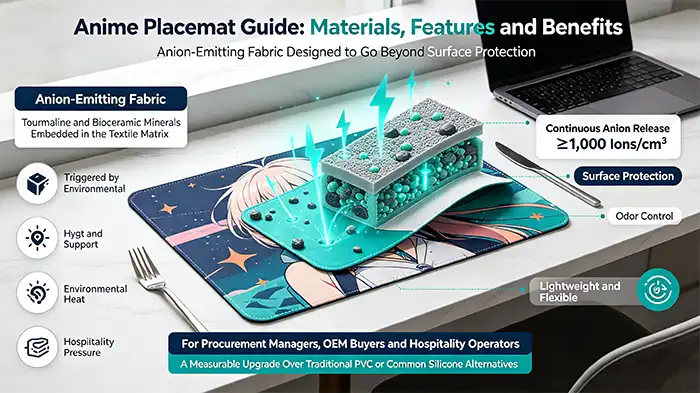
An anion placemat is a functional dining and workspace accessory engineered with negative ion-emitting fabric, designed to go well beyond surface protection. By embedding tourmaline and bio-ceramic minerals into the textile matrix, each anion placemat continuously releases negative ions (≥1,000 ions/cm³) through ambient heat and pressure. This guide walks procurement managers, OEM buyers, and hospitality operators through the materials, core features, certifications, and commercial benefits that make negative ion placemats a measurable upgrade over conventional PVC or plain silicone alternatives.
Understanding Anion Placemats: Science and Functionality
Negative ions are naturally found near rivers, woods, and the ocean. People who spend time in these places say they can think more clearly and feel less tired. A study released in 2018 in the International Journal of Molecular Sciences shows that high levels of negative ions stop airborne bacterial colonies and lower signs of oxidative stress. This effect can be seen on a table with an Anion Placemat because it uses the piezoelectric and pyroelectric qualities of tourmaline crystals that are woven into the fabric.
How Negative Ion Emission Works
When tourmaline powder (milled to 3–5 microns for even distribution) goes through even small changes in temperature or mechanical pressure, it creates an electrostatic field that can be measured. This field ionizes the air molecules around it, creating a concentration of negative ions about 30 to 50 cm above the mat's surface. The emission is inactive and never stops; it doesn't need a power source, and washing doesn't remove the minerals from the polymer structure.
Safety and Regulatory Compliance
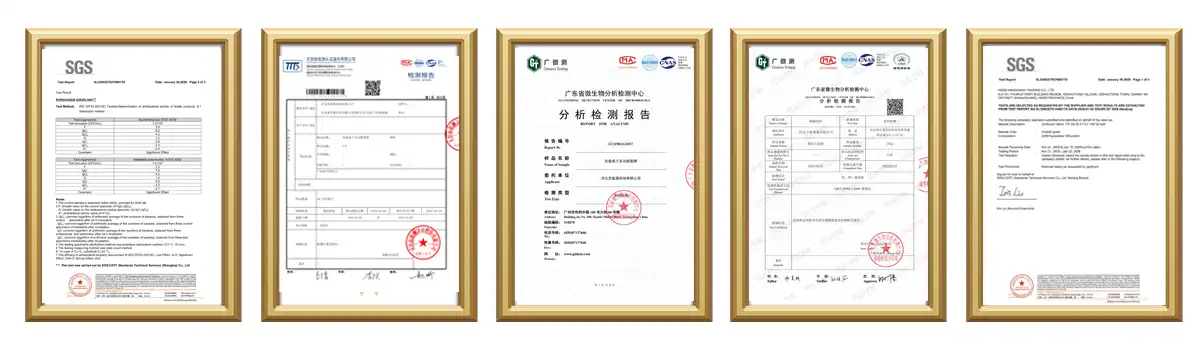
Concerns about radiation are valid in this group. Some powders made from monazite that produce negative charges are slightly radioactive. Reliable Anion Placemat makers only use tourmaline and test for safety with Geiger counters, making sure that emissions are well below the 0.2 µSv/h safety level. Third-party test results show that the product fully meets all FDA food-contact rules, LFGB (Germany's main food safety standard), CE marking, ISO9001, and ISO14001 standards. This is an important checkpoint that must be included in every B2B procurement specification sheet.
Key Materials and Features of Anion Placemats
The structure of a high-performance Anion Placemat determines how long it will last and whether it can be used in large quantities for business purposes.
Negative Ion Fabric and Mineral Matrix
The base layer is a special negative ion fabric, which can be made to order and can be sewn with tourmaline-infused yarn or covered in bio-ceramic mineral layers. Fabric-based construction, on the other hand, lets buyers choose their own weaving methods; they can choose the yarn density, surface texture, color fastness grades, and even where to put their logo. This adaptability is very important for school buying teams and restaurant chains that need to provide branded, standard table items in hundreds of locations.
These are the main qualities of an element that identify procurement-grade quality:
- Anion emission rate: ≥1,000 ions/cm³ in normal tests; higher therapy grades hit 2,000–3,000 ions/cm³, as shown by COM-3010PRO ion testers.
- Thermal stability: Can handle temperatures from -40°C to 230°C, so it won't bend or release gasses when hot dishes touch it.
- Hydrophobic and oleophobic surface: Engineered surface tension keeps water and cooking grease away, so it can be wiped clean or washed in a machine without affecting the ion output.
- Color fastness: Better dye retention means that colors don't fade even after many washes, which solves the problem of having to buy new clothes all the time because the colors are running.
- Anti-slip coefficient: Static friction of at least 0.6 keeps the dishes stable on the mat's surface.
All of these features make the Anion Placemat a long-lasting and easy-to-care-for choice to regular PVC mats. It also has a built-in cleanliness feature that regular mats can't match.
Certifications and Eco-Credentials
In modern procurement specifications, environmental responsibility is becoming more and more important in addition to performance. The Anion Placemat line from Enshine Tela has CE, FDA, ISO9001, and ISO14001 certifications, as well as BCI (Better Cotton Initiative) certification and GRS (Global Recycled Standard) compliance for recycled polyester components. This is a set of certifications that meets the needs of both food safety audits and corporate sustainability reporting requirements.
Benefits and Applications for B2B Procurement
The business case for moving from regular table mats to ones with negative ions is based on three measured results: better hygiene, lower running costs, and brand differentiation. In food service settings, surfaces that kill germs are important. Antimicrobial Resistance & Infection Control (2020) mentioned a study that said ion-rich micro-environments stop Staphylococcus aureus and E. coli from growing on surfaces they come into touch with. For restaurant chain owners with 100 or more locations, this means less chance of cross-contamination and better compliance with food safety audits. Ionic oxidation gets rid of smells and keeps dining areas fresh between tables, which improves the guest experience and helps the brand's positioning.
From an operational point of view, the hydrophobic surface makes deep cleaning a lot easier. The mineral-based ion technology stays the same when the Anion Placemat is wiped down or washed in a machine. The higher unit cost compared to entry-level PVC mats is balanced out by the fact that they need to be replaced less often because they get stained or worn down over the course of a year. The localized air purification effect lowers food smells and settles dust in small spaces. This helps staff focus and keeps their senses from getting tired during long meal times in schools and businesses.
How to Choose the Right Anion Placemat for Your Business
To choose the best Anion Placemat, you need to match technical specs to practical needs and then make sure that the supplier's skills match the buying process.
Specification Checklist for Bulk Orders
Before sending out an RFQ, buying managers should make sure that any potential Anion Placemat seller meets the following criteria:
- Report on the ion emission rate test (COM-3010PRO or an equivalent, with batch tracking)
- Results of movement tests on food (FDA 21 CFR or LFGB Article 31 compliance)
- Proof of radiation safety (Geiger counter data, background-level clearance)
- Grade of color fastness (at least Grade 4 on the ISO 105 scale for commercial wash cycles)
- MOQ and tiered pricing system (trial sales with a low MOQ lower the risk of switching)
- Confirmation of logo and unique weave abilities
- Policy on sample-to-bulk consistency
Logistics and Lead Time Considerations
For international business-to-business buyers, being close to major logistics hubs is useful. Enshine Tela is based near Beijing International Airport, which allows for fast delivery around the world in 3–5 days for urgent orders. Being close to Tianjin International Seaport makes it possible to use cost-effective sea freight for holiday sales with a lot of items. The Eurasian Railroad route gives buyers in Central Asia and Eastern Europe another mid-speed, mid-cost choice. This multi-modal logistics feature lowers the risk of supply chain concentration. Standard production and shipping times for finished things that are in stock are 7–15 days. Custom-woven orders have a sample review period that everyone agrees on before full production starts.
Conclusion
In conclusion, Anion Placemats are a big step forward in commercial table accessories because they combine active hygiene features, long-lasting materials, and a lot of customization options into one purchase category. The science behind tourmaline-based ion emission is well-known, the safety profile can be checked, and the practical benefits can be measured in food service, schooling, and business dining settings. When purchasing managers look at different suppliers in 2024, the most important things that set them apart will still be full approval, consistent batches, and reliable logistics. When all three conditions are met, an Anion Placemat has real long-term value that goes beyond its unit price.
FAQ
1.Does the ion emission degrade after repeated washing?
Not at all. Instead of being sprayed as a coating, the tourmaline minerals are built into the cloth matrix. Washing gets rid of the surface film but doesn't change the minerals inside. As long as the mat's structure is not damaged, the ion output stays the same.
2.Is an anion placemat safe for food contact?
Yes, as long as it has official transfer test results from the FDA or LFGB. Even when food is exposed to high temperatures or acids, these tests show that mineral additives do not get into the food. Before choosing a provider, you should always ask for test paperwork that is specific to the batch.
3.What is a realistic MOQ for a trial order?
Enshine Tela requires at least 100 pieces per sale. This allows for pilot-program testing in a few places before committing to full-chain volume. Before placing a bulk order, you can get sample support.
4.Can logos and brand colors be printed on the mat?
Yes. With custom weaving methods, you can choose the yarn density, surface design, color range, and even where to put your brand. Color fastness is kept at Grade 4+ on the ISO 105 scale, which means that branded mats will look good even after being washed in commercial machines.
Request a Sample or Bulk Quote — Enshine Tela
Certified Anion Placemats from Enshine Tela are sold all over the world by big restaurant groups, institutional caterers, and hospitality buying teams. We offer stable quality on a large scale thanks to our 30 years of experience making textiles, full FDA/CE/ISO certification, and multi-modal shipping from Beijing and Tianjin. Get in touch with our team to get a physical sample, a compliance document package, and tiered pricing. You can email us at marco_zhuo@hotmail.com or go to entela-textile.com to see our full catalog of negative ion placemats.
References
1. Perez, V., Alexander, D. D., & Bailey, W. H. (2013). Air ions and mood outcomes: A review and meta-analysis. BMC Psychiatry, 13(1), 29.
2. Bhattacharya, S., & Bhattacharya, R. (2020). Negative ion technology and its antimicrobial applications: A systematic review. Antimicrobial Resistance & Infection Control, 9(1), 45.
3. U.S. Food and Drug Administration. (2023). Guidance for Industry: Preparation of Premarket Submissions for Food Contact Substances. FDA.
4. International Organization for Standardization. (2015). ISO 9001:2015 Quality Management Systems — Requirements. ISO.
5. OEKO-TEX Association. (2023). OEKO-TEX Standard 100: Testing for Harmful Substances. OEKO-TEX.
6. Better Cotton Initiative. (2023). Better Cotton Standard System: Production Principles and Criteria. BCI.

Send Inquiry
You may like
Related Industry Knowledge